Describir graficos y tablas en ingles para stakeholders internacionales
Actualizado: 14 de enero de 2025
Ya sea que presentes los resultados trimestrales al consejo, compartas un estudio de mercado con un cliente, o redactes un informe para stakeholders internacionales, describir graficos y tablas con precision en ingles es una habilidad que impacta directamente en como se percibe tu trabajo.
Muchos profesionales pueden crear graficos excelentes pero tienen dificultades para narrarlos de forma efectiva en ingles. Los datos son claros. El lenguaje que los rodea, no tanto. Aqui tienes como solucionarlo.
Tipos de graficos y como introducirlos
Graficos de lineas (Line graphs)
- “This line graph shows the trend in customer acquisition over the past three years.”
- “As you can see from this chart, revenue has followed an upward trajectory since Q2.”
Graficos de barras (Bar charts)
- “This bar chart compares sales figures across our five key markets.”
- “The bars represent monthly revenue, with each colour indicating a different product line.”
Graficos circulares (Pie charts)
- “This pie chart breaks down our revenue by sector.”
- “As the chart shows, the largest segment is B2B services, accounting for 42% of total revenue.”
Tablas (Tables)
- “This table summarises the key metrics for each quarter.”
- “If we look at the third column, we can see the year-on-year change.”
Describir lo que ves
Empezar tu descripcion
- “Let me draw your attention to…”
- “If we look at the data for Q3…”
- “The most striking feature of this graph is…”
- “What stands out immediately is…”
Describir tendencias
Usa vocabulario variado para evitar la repeticion:
Tendencias al alza:
- “Sales rose steadily from January to March.”
- “There was a sharp increase in demand during the summer months.”
- “Customer numbers climbed gradually throughout the year.”
Tendencias a la baja:
- “Costs fell significantly in the second half.”
- “There was a noticeable decline in engagement after July.”
- “Revenue dipped briefly before recovering in September.”
Picos y valles:
- “Revenue peaked at 4.2 million in June.”
- “The lowest point was reached in February, at just under 2 million.”
- “After reaching a high of 85%, satisfaction scores dropped back to 78%.”
Periodos estables:
- “Prices remained relatively stable throughout Q4.”
- “There was little change between March and May.”
- “The figures levelled off at around 60%.”
Comparar datos
- “Region A outperformed Region B by approximately 15%.”
- “The gap between the two product lines narrowed significantly.”
- “In contrast to last year, Q1 showed stronger growth.”
- “While domestic sales remained flat, international revenue grew by 22%.”
Destacar lo que importa
Tu audiencia no necesita que describas cada punto de datos. Pueden leer el grafico por si mismos. Tu trabajo es guiar su atencion hacia lo que importa.
Llamar la atencion sobre puntos clave
- “The key takeaway here is…”
- “What this tells us is…”
- “The significant thing to note is…”
- “I want to highlight one figure in particular…”
Proporcionar contexto
- “This increase coincides with our expansion into the German market.”
- “The dip in March was due to the seasonal slowdown.”
- “When we adjust for inflation, the picture changes considerably.”
- “Compared to the industry average of 5%, our 12% growth is significant.”
Hacer recomendaciones basadas en datos
- “Based on these figures, I would recommend…”
- “The data suggests that we should…”
- “If this trend continues, we will need to…”
Errores comunes al presentar datos
Error 1: Leer el grafico literalmente
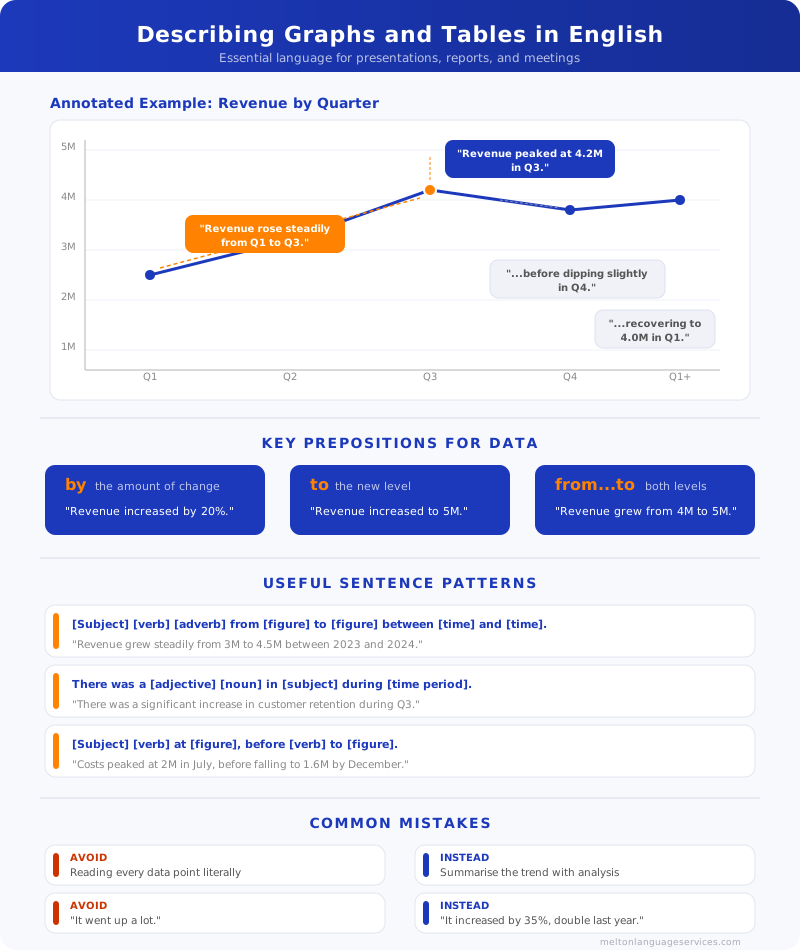
“In January it was 100. In February it was 110. In March it was 108.” Eso es una lista, no un analisis. En su lugar: “There was a slight upward trend in the first quarter, with a small dip in March.”
Error 2: Usar lenguaje vago
“It went up a lot.” Cuanto es “a lot”? Se especifico: “It increased by 35%, which is more than double the growth rate we saw last year.”
Error 3: Confundir preposiciones
- Revenue increased by 20% (la cantidad de cambio)
- Revenue increased to 5 million (el nuevo nivel)
- Revenue increased from 4 million to 5 million (ambos niveles)
Error 4: Ignorar a la audiencia
Los equipos tecnicos quieren precision. La alta direccion quiere el titular y la implicacion. Ajusta tu lenguaje en consecuencia.
Patrones de frases utiles
Aqui tienes plantillas que puedes adaptar:
-
“[Sujeto] [verbo] [adverbio] from [cifra] to [cifra] between [tiempo] and [tiempo].” Revenue grew steadily from 3 million to 4.5 million between 2023 and 2024.
-
“There was a [adjetivo] [sustantivo] in [sujeto] during [periodo].” There was a significant increase in customer retention during Q3.
-
“[Sujeto] [verbo] at [cifra], before [verbo] to [cifra].” Costs peaked at 2 million in July, before falling to 1.6 million by December.
Practicar con datos reales
La mejor forma de mejorar es practicar con datos de tu propio trabajo:
- Coge un grafico de un informe reciente
- Describelo en voz alta en ingles durante dos minutos
- Grabate
- Escuchate y observa donde tu lenguaje podria ser mas preciso
- Repite con diferentes graficos
Hazlo semanalmente y en un mes, presentar datos en ingles te resultara natural.
Puntos clave
- Introduce los graficos con claridad indicando lo que muestran
- Usa vocabulario variado para describir tendencias
- Centrate en lo que importa, no en cada punto de datos
- Domina las preposiciones: by, to, from
- Practica con los datos de tu propio trabajo para mejorar mas rapido
Una comunicacion de datos clara construye credibilidad. Cuando puedes guiar a los stakeholders a traves de un grafico con confianza y precision, los datos trabajan mas para ti.