Describing Graphs and Tables in English: Key Phrases
Updated: 13 April 2026
A well-designed chart can tell a compelling story in seconds. But in international business, you rarely let a chart speak for itself. You are expected to walk your audience through it, highlight what matters, and connect the data to a recommendation. That requires specific English vocabulary and structures that many professionals never formally learn.
The result is a common gap: you can create excellent charts but struggle to narrate them effectively. The data is clear, but the language around it falls flat. Here is how to close that gap.
Types of charts and how to introduce them
Line graphs
- “This line graph shows the trend in customer acquisition over the past three years.”
- “As you can see from this chart, revenue has followed an upward trajectory since Q2.”
Bar charts
- “This bar chart compares sales figures across our five key markets.”
- “The bars represent monthly revenue, with each colour indicating a different product line.”
Pie charts
- “This pie chart breaks down our revenue by sector.”
- “As the chart shows, the largest segment is B2B services, accounting for 42% of total revenue.”
Tables
- “This table summarises the key metrics for each quarter.”
- “If we look at the third column, we can see the year-on-year change.”
Describing what you see
Starting your description
- “Let me draw your attention to…”
- “If we look at the data for Q3…”
- “The most striking feature of this graph is…”
- “What stands out immediately is…”
Describing trends
Use varied vocabulary to avoid repetition:
Upward trends:
- “Sales rose steadily from January to March.”
- “There was a sharp increase in demand during the summer months.”
- “Customer numbers climbed gradually throughout the year.”
Downward trends:
- “Costs fell significantly in the second half.”
- “There was a noticeable decline in engagement after July.”
- “Revenue dipped briefly before recovering in September.”
Peaks and troughs:
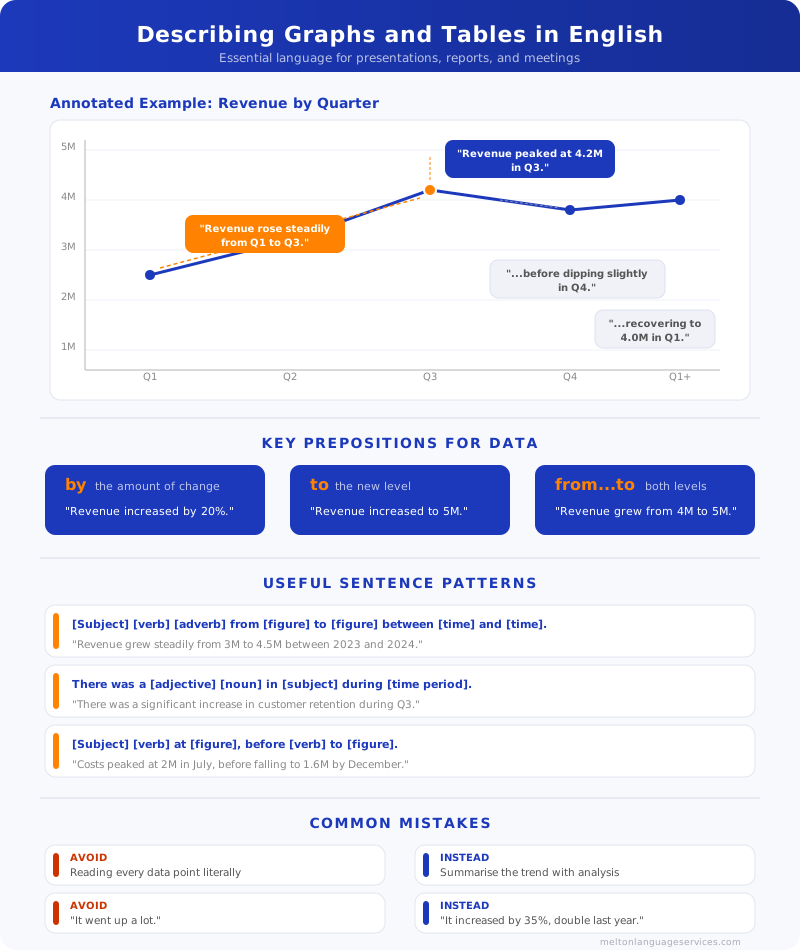
- “Revenue peaked at 4.2 million in June.”
- “The lowest point was reached in February, at just under 2 million.”
- “After reaching a high of 85%, satisfaction scores dropped back to 78%.”
Stable periods:
- “Prices remained relatively stable throughout Q4.”
- “There was little change between March and May.”
- “The figures levelled off at around 60%.”
Comparing data points
- “Region A outperformed Region B by approximately 15%.”
- “The gap between the two product lines narrowed significantly.”
- “In contrast to last year, Q1 showed stronger growth.”
- “While domestic sales remained flat, international revenue grew by 22%.”
Highlighting what matters
Your audience does not need you to describe every data point. They can read the chart themselves. Your job is to guide their attention to what matters.
Drawing attention to key points
- “The key takeaway here is…”
- “What this tells us is…”
- “The significant thing to note is…”
- “I want to highlight one figure in particular…”
Providing context
- “This increase coincides with our expansion into the German market.”
- “The dip in March was due to the seasonal slowdown.”
- “When we adjust for inflation, the picture changes considerably.”
- “Compared to the industry average of 5%, our 12% growth is significant.”
Making recommendations based on data
- “Based on these figures, I would recommend…”
- “The data suggests that we should…”
- “If this trend continues, we will need to…”
Common mistakes when presenting data
Mistake 1: Reading the chart literally
“In January it was 100. In February it was 110. In March it was 108.” This is a list, not an analysis. Instead: “There was a slight upward trend in the first quarter, with a small dip in March.”
Mistake 2: Using vague language
“It went up a lot.” How much is “a lot”? Be specific: “It increased by 35%, which is more than double the growth rate we saw last year.”
Mistake 3: Mixing up prepositions
- Revenue increased by 20% (the amount of change)
- Revenue increased to 5 million (the new level)
- Revenue increased from 4 million to 5 million (both levels)
Mistake 4: Ignoring the audience
Technical teams want precision. Senior leadership wants the headline and the implication. Adjust your language accordingly.
Useful sentence patterns
Here are templates you can adapt:
-
“[Subject] [verb] [adverb] from [figure] to [figure] between [time] and [time].” Revenue grew steadily from 3 million to 4.5 million between 2023 and 2024.
-
“There was a [adjective] [noun] in [subject] during [time period].” There was a significant increase in customer retention during Q3.
-
“[Subject] [verb] at [figure], before [verb] to [figure].” Costs peaked at 2 million in July, before falling to 1.6 million by December.
Practising with real data
The best way to improve is to practise with data from your own work:
- Take a chart from a recent report
- Describe it out loud in English for two minutes
- Record yourself
- Listen back and note where your language could be more precise
- Repeat with different charts
Do this weekly and within a month, presenting data in English will feel natural.
Presenting data in virtual meetings
With remote and hybrid work now standard across most European companies, many data presentations happen over video calls. This adds specific challenges:
- Reference your visuals explicitly. On a shared screen, say “If you look at the blue line on the left” rather than pointing. Your audience may be on a small screen and need verbal guidance.
- Pause after sharing a chart. Give people three to five seconds to orient themselves before you start talking. On a call, there is often a slight delay before shared content appears on everyone’s screen.
- Summarise before moving on. Say “So the key point from this chart is…” before switching to the next slide. In a physical meeting, people can glance back at a chart. On a call, once it is gone, it is gone.
These small adjustments make a significant difference in how clearly your data lands with a remote audience.
Key takeaways
- Introduce charts clearly by stating what they show
- Use varied vocabulary to describe trends
- Focus on what matters, not every data point
- Master the prepositions: by, to, from
- Practise with your own work data for the fastest improvement
Clear data communication builds credibility. When you can walk stakeholders through a chart with confidence and precision, the data does more work for you.