AI Tools for Language Learning at Work: What Actually Helps
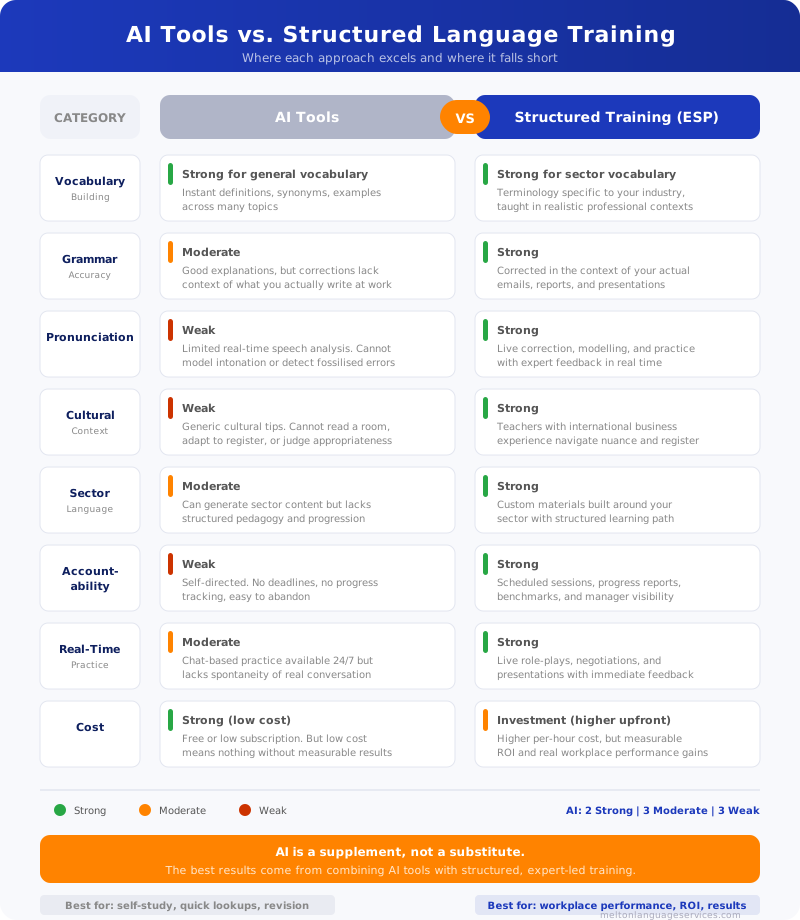
AI tools for language learning have improved dramatically. Your team can practise vocabulary with a chatbot at midnight, get instant grammar corrections on a draft email, and transcribe meetings in real time. The question is not whether these tools are useful — they clearly are. The question is whether they are enough on their own, and where they fall short in a professional context.
The AI hype vs. the reality
Every few months, a new article claims AI will replace language teachers and structured training entirely. The reality is more nuanced. AI tools are powerful for certain tasks, but language is not just a technical skill. It involves reading a room, understanding cultural expectations, and adapting your register depending on who you are talking to. No chatbot does that reliably yet.
For managers evaluating options, the practical question is not “AI or human training?” but “what combination gives us the best return?”
What AI tools do well
Give credit where it is due. AI tools handle several things effectively:
Vocabulary and grammar drills. Spaced repetition apps and AI-powered quizzes are excellent for building and retaining vocabulary. They adapt to your level, track weak points, and never lose patience.
Writing correction. AI writing assistants can catch grammatical errors, suggest clearer phrasing, and flag awkward constructions in real time. For professionals sending emails in a second language, this is genuinely valuable.
Pronunciation feedback. Several tools now offer real-time pronunciation scoring. They are not perfect, but they give learners a way to practise speaking without needing another person present.
Real-time translation and transcription. Meeting transcription and live translation lower the barrier to participation in multilingual teams. They are practical aids rather than learning tools, but they reduce the anxiety that often blocks progress.
What AI tools cannot do
Here is where things get honest:
Nuance and tone. AI can tell you a sentence is grammatically correct. It cannot reliably tell you whether it sounds too direct for a client email, too casual for a board presentation, or too formal for a team check-in. Tone is contextual, and context is something AI still handles poorly.
Cultural communication. How you structure an argument, deliver bad news, or handle disagreement in a meeting varies enormously across cultures and industries. AI tools trained on generic data do not account for the specific communication norms your team operates in.
Sector-specific language. If your team works in finance, defence, engineering, or pharma, they need vocabulary and communication patterns specific to that sector. Generic AI tools produce generic language. They do not know the difference between how a procurement officer and a project manager use the same terms.
Accountability and structure. AI tools are available whenever you want them, which also means they are easy to ignore. There is no schedule, no progression plan, and no one checking whether learning is actually happening.
Tools worth trying
Without endorsing specific products, here are categories worth exploring:
AI chatbots (for conversation practice): useful for low-stakes speaking and writing practice. Ask them to simulate work scenarios, correct your output, or explain why a phrase sounds unnatural.
Writing assistants (for email and document drafting): helpful for catching errors in real time. The key is to read the corrections rather than just accepting them — that is where learning happens.
Transcription tools (for meetings and calls): useful for reviewing what was said after the fact, identifying words you missed, and building listening skills passively.
Pronunciation apps (for individual practice): good for drilling sounds and intonation patterns outside of class. Most effective when combined with feedback from a real person.
How to use AI tools alongside structured training
The strongest approach is not AI or structured training. It is both, with clear roles for each.
Use AI tools for daily practice between sessions — vocabulary review, writing corrections, low-pressure conversation practice. Use structured training for the things AI cannot deliver: needs analysis, sector-specific material, real-time feedback on tone and register, and a progression plan that ties to actual business objectives.
Think of it like fitness. AI tools are the home workout. Structured training is the coach who designs your programme, corrects your form, and adjusts the plan when something is not working.
The risk of over-relying on AI
There is a real risk that teams use AI tools as a replacement for training rather than a complement to it. The result is usually learners who can produce grammatically correct sentences but struggle in real meetings, negotiations, or presentations. Writing an email with AI assistance is not the same as being able to handle a difficult phone call.
The other risk is false confidence. AI tools are encouraging by design. They do not tell you that your English, while technically correct, sounds robotic or inappropriately formal. A human trainer will.
What managers should know before recommending AI tools
If you are responsible for your team’s language development, keep these points in mind:
AI tools work best for motivated, self-directed learners. If someone already has good study habits, AI tools accelerate their progress. If they do not, the tools tend to gather digital dust.
Not all roles need the same thing. A developer who mostly writes documentation has different needs from a sales lead who runs client calls in English. One might benefit heavily from a writing assistant. The other needs live practice with feedback.
Measure outcomes, not activity. Logging into an app is not the same as improving. Look for evidence of progress in actual work situations — better emails, more confident presentations, fewer misunderstandings in meetings.
Free tools have limits. Most AI language tools offer a free tier and a paid version. The free versions are fine for casual practice but often lack the depth needed for professional development.
The bottom line: AI as supplement, not substitute
AI tools are a genuine asset for language learning at work. They lower barriers, increase practice time, and give learners resources that did not exist five years ago. But they do not replace structured, expert-led training — especially when the goal is professional communication in a specific sector.
The most effective language development programmes use AI tools to extend learning between sessions, while relying on tailored training to build the skills that actually matter in high-stakes professional situations. That combination is where the real results come from.