Email English: Phrases That Make You Sound Professional
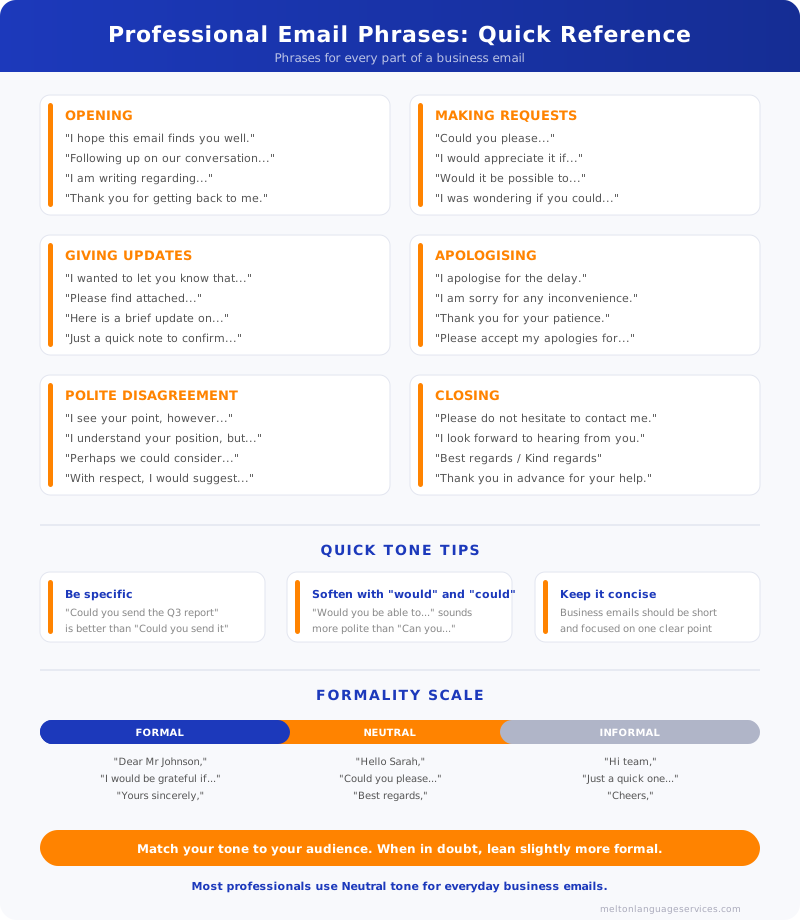
Email is still the backbone of professional communication. For many people working in English as a second language, writing emails can be one of the most time-consuming parts of the day. You know what you want to say, but finding the right tone and phrasing takes effort.
The good news is that professional email English relies heavily on a set of common patterns and phrases. Once you learn them, writing emails becomes faster and more natural. This guide covers the phrases you need for the most common email situations, from opening to closing.
Setting the right tone
Professional emails in English sit somewhere between formal and conversational. You are not writing a legal document, but you are not texting a friend either. The general rules:
- Be polite but direct. Get to the point without being blunt.
- Use complete sentences. Avoid one-word replies to external contacts.
- Match the other person’s level of formality. If they write “Hi John,” you can reply the same way. If they write “Dear Mr. Smith,” keep it formal.
- When in doubt, lean slightly more formal. You can always become less formal once a relationship is established.
Opening your email
First contact with someone you have not met
- “Dear [Name], I’m writing to enquire about…”
- “Dear [Name], I’m reaching out regarding…”
- “Dear [Name], I found your details on [source] and I’d like to discuss…”
Following up on a previous conversation
- “Thank you for your time earlier today.”
- “Following our conversation on [date/topic], I wanted to…”
- “As discussed, please find attached…”
- “Further to our meeting yesterday, here is a summary of…”
Replying to someone’s email
- “Thank you for your email.”
- “Thanks for getting back to me so quickly.”
- “Thank you for the information.”
- “Thanks for sending this over.”
When you have not been in touch for a while
- “I hope you’re doing well.”
- “I hope this email finds you well.”
- “It’s been a while since we last spoke. I wanted to get in touch about…”
A note on “I hope this email finds you well.” Some people find this phrase overused. It is perfectly acceptable in professional English, but if you want an alternative, simply skip the pleasantry and go straight to your purpose.
Making requests
One of the trickiest areas in email English is making requests that sound polite without sounding weak or vague. Here are phrases ranked from more formal to less formal:
Formal requests
- “I would be grateful if you could…”
- “Would it be possible to…?”
- “I would appreciate it if you could…”
- “Could you kindly…?”
Standard professional requests
- “Could you please send me…?”
- “Would you be able to…?”
- “I’d like to request…”
- “Please let me know if…”
Less formal (for colleagues you know well)
- “Can you send me…?”
- “Would you mind…?”
- “Could you…?”
Requesting information
- “Could you provide me with details on…?”
- “I’d like to find out more about…”
- “Do you have any information regarding…?”
Requesting a meeting
- “Would you be available for a call next week?”
- “Could we schedule a meeting to discuss…?”
- “I’d like to set up a meeting at your earliest convenience.”
- “Are you free on [date] at [time]?”
Giving information and updates
- “I’m writing to let you know that…”
- “I wanted to update you on…”
- “Please find attached the [document].”
- “As requested, I’m sending you…”
- “For your reference, I’ve included…”
- “Please note that…”
- “I’d like to confirm that…”
Apologising and acknowledging delays
- “I apologise for the delay in getting back to you.”
- “Sorry for the late reply.”
- “I’m sorry for any inconvenience this may have caused.”
- “Thank you for your patience.”
- “I apologise for the confusion.”
Notice that “Thank you for your patience” is often more effective than “Sorry for the delay.” It frames the situation positively and acknowledges the other person’s understanding.
Disagreeing politely
Professional disagreement in English requires careful phrasing. Being too direct can sound aggressive, while being too indirect can cause confusion.
- “I see your point, but I think we should also consider…”
- “I understand your perspective. However, I would suggest…”
- “That’s a valid point. From our side, though, we feel that…”
- “I appreciate the suggestion. My concern is that…”
- “I’m not sure that would work for us because…”
Chasing a response
Following up without sounding pushy is an art. These phrases strike the right balance:
- “I just wanted to follow up on my previous email.”
- “I’m writing to check whether you’ve had a chance to look at…”
- “I wanted to make sure my email didn’t get lost in your inbox.”
- “I’d appreciate an update when you get a chance.”
- “Could you let me know where we stand on this?”
If it has been a long time with no reply:
- “I appreciate you may be busy, but I’d be grateful for an update on…”
- “I’m following up on the email I sent on [date] regarding…”
Closing your email
Before the sign-off
- “Please don’t hesitate to contact me if you have any questions.”
- “I look forward to hearing from you.”
- “Let me know if you need anything else.”
- “I’d be happy to discuss this further.”
- “Thank you in advance for your help.”
- “I look forward to your reply.”
Sign-offs
- Formal: “Kind regards,” / “Best regards,” / “Yours sincerely,”
- Standard professional: “Best regards,” / “Many thanks,” / “Thanks,”
- Informal (colleagues): “Best,” / “Thanks,” / “Cheers,”
“Best regards” is the safest all-purpose sign-off in professional English. It works for almost every situation.
Phrases to avoid
Some phrases that non-native speakers commonly use can sound awkward or overly stiff in professional English:
- “Dear Sir/Madam”: Use this only when you genuinely do not know who you are writing to. If you have a name, use it.
- “I am writing to inform you that”: This is very formal and can sound cold. Prefer “I wanted to let you know that” or “I’m writing to update you on.”
- “Please revert”: Common in some regions but not standard in British or American English. Use “Please reply” or “Please get back to me.”
- “Do the needful”: Not used in standard British or American English. Be specific about what you need.
- “Kindly do the same”: Vague. State clearly what you are asking for.
Building your email vocabulary over time
The best way to improve your email English is to pay attention to the emails you receive from native speakers or fluent colleagues. Notice which phrases they use for requests, follow-ups, and closings. Keep a list of phrases that sound natural and professional, and start incorporating them into your own emails.
You will find that after a few weeks of conscious practice, many of these phrases become automatic. Writing emails in English stops being a translation exercise and becomes a natural part of your working day.
If you want to accelerate this process, working with a teacher who can review your real emails and give specific feedback is one of the fastest ways to improve. At Melton Language Services, our ESP programmes include exactly this kind of practical, work-based training. If your team writes emails in English every day and you want them to communicate more effectively, let us know how we can help.