English Conditionals: Zero, First, Second, and Third Explained
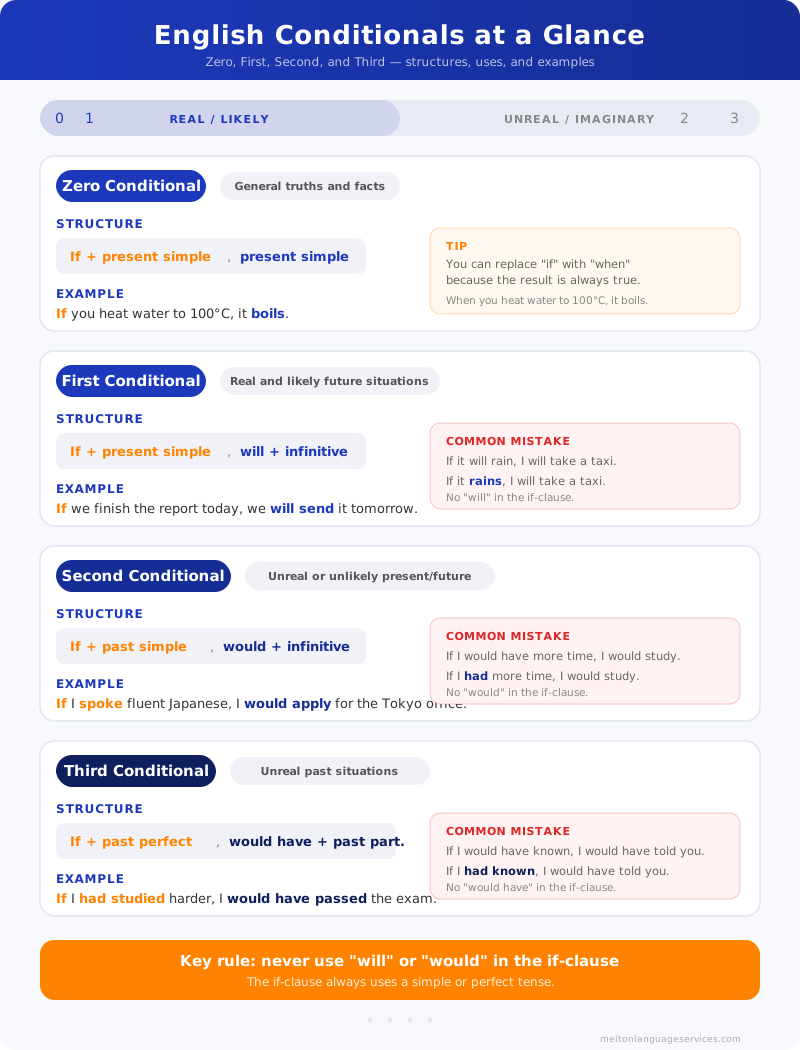
Conditionals are one of the most useful structures in English, and one of the most commonly confused. If you have ever hesitated between “if I have” and “if I had,” or wondered when to use “would” versus “will,” this guide is for you.
There are four main conditionals in English. Each one describes a different relationship between a condition and its result. Let us go through them one by one.
Zero conditional: General truths and facts
The zero conditional describes things that are always true. If the condition happens, the result always happens. There is no uncertainty.
Structure
If + present simple, present simple
Examples
- “If you heat water to 100°C, it boils.”
- “If employees feel valued, they perform better.”
- “If the client does not receive the invoice by Friday, the payment is late.”
When to use it
Use the zero conditional for scientific facts, general rules, and things that are always true in your experience. It is common in business for describing policies and procedures:
- “If a candidate scores below B2, we do not proceed to the second interview.”
- “If the system detects an error, it sends an automatic notification.”
Key point
You can replace “if” with “when” in the zero conditional without changing the meaning, because the result is always true: “When you heat water to 100°C, it boils.”
First conditional: Real and likely future situations
The first conditional describes situations that are possible and likely to happen. The speaker sees the condition as realistic.
Structure
If + present simple, will + infinitive
Examples
- “If we finish the report today, we will send it to the client tomorrow.”
- “If it rains, I will take a taxi to the meeting.”
- “If you practise every day, you will see results within a month.”
When to use it
Use the first conditional for plans, predictions, promises, and warnings about the future:
- “If you do not confirm by Monday, we will offer the place to another candidate.”
- “If the budget is approved, we will start the project in Q2.”
- “If you need anything, I will be in my office until six.”
Common variations
You do not always need “will” in the result clause. Other modal verbs work too:
- “If you finish early, you can leave.” (permission)
- “If the client calls, you should take the message.” (advice)
- “If there is a problem, you must notify the manager.” (obligation)
Common mistake
Do not use “will” in the if-clause. “If it will rain, I will take a taxi” is wrong. The correct form is: “If it rains, I will take a taxi.”
Second conditional: Unreal or unlikely present/future situations
The second conditional describes situations that are imaginary, unlikely, or contrary to reality right now. The speaker sees the condition as hypothetical.
Structure
If + past simple, would + infinitive
Examples
- “If I spoke fluent Japanese, I would apply for the Tokyo office.”
- “If we had a bigger budget, we would hire two more developers.”
- “If I were you, I would accept the offer.”
When to use it
Use the second conditional for hypothetical scenarios, giving advice, and talking about situations that are not true right now:
- “If we offered remote work, we would attract more candidates.” (But we do not offer it.)
- “If I had more time, I would learn another language.” (But I do not have more time.)
- “If the company invested in training, productivity would improve.” (But it does not invest.)
”Was” or “were”?
In formal English, use “were” for all subjects in the second conditional: “If I were the manager…” / “If she were here…” In everyday speech, “was” is common with I/he/she/it (“If I was the manager…”), but “were” is always correct and sounds more polished in professional contexts.
Common mistake
Do not use “would” in the if-clause. “If I would have more time, I would study” is wrong. The correct form is: “If I had more time, I would study.”
Third conditional: Unreal past situations
The third conditional describes situations that did not happen in the past. It is used to imagine a different past and its imaginary result. You cannot change anything — it is too late.
Structure
If + past perfect, would have + past participle
Examples
- “If I had studied harder, I would have passed the exam.”
- “If we had known about the delay, we would have informed the client.”
- “If she had accepted the job, she would have moved to Berlin.”
When to use it
Use the third conditional for regrets, missed opportunities, and analysing what went wrong:
- “If we had started the project earlier, we would have met the deadline.”
- “If I had prepared better, the presentation would have gone more smoothly.”
- “If they had checked the contract, they would have noticed the error.”
Common variations
- “If I had known, I could have helped.” (past ability)
- “If we had asked, they might have agreed.” (past possibility)
Common mistake
Do not use “would have” in the if-clause. “If I would have known, I would have told you” is wrong. The correct form is: “If I had known, I would have told you.”
Quick comparison
Here is how the same topic looks across all four conditionals:
| Conditional | Example | Meaning |
|---|---|---|
| Zero | ”If I drink coffee after 6pm, I cannot sleep.” | This always happens. |
| First | ”If I drink coffee after 6pm, I will not sleep tonight.” | This is likely to happen today. |
| Second | ”If I drank coffee after 6pm, I would not sleep.” | I am imagining the situation (I do not plan to). |
| Third | ”If I had drunk coffee after 6pm, I would not have slept.” | I did not drink it, so I slept fine. |
Mixed conditionals
Sometimes you need to mix the second and third conditionals. This happens when a past event has a present result, or a present state had a past consequence.
Past cause, present result
If + past perfect, would + infinitive
- “If I had accepted that job in 2020, I would be living in London now.”
- “If we had invested in language training earlier, the team would be more confident today.”
Present state, past consequence
If + past simple, would have + past participle
- “If I were more patient, I would have handled that meeting better.”
- “If she spoke French, she would have got the contract.”
Tips for getting conditionals right
- Identify the time and reality first. Before choosing a conditional, ask yourself: is this real or imaginary? Present/future or past?
- Keep “would” and “will” out of the if-clause. This is the single most common mistake with conditionals. The if-clause uses a simple or perfect tense, never “will” or “would.”
- Use contractions in speech. “I’d” (I would/I had), “we’ll” (we will), “they’d have” (they would have). Conditionals are long structures, and native speakers almost always contract them.
- Practise with real decisions. Think about your work: “If I had prepared differently for that presentation…” or “If we change the deadline, we will need to…” Real context makes the grammar stick.
A note on “unless”
“Unless” means “if not” and is common in business English:
- “Unless you confirm by Friday, we will cancel the booking.” (= If you do not confirm…)
- “Unless there is a problem, the delivery will arrive on Monday.” (= If there is not a problem…)
“Unless” only works with first and zero conditionals. Do not use it with second or third conditionals.
Conditionals are structures you will use every day in professional English — in emails, meetings, negotiations, and reports. The key is not to memorise rules but to practise using them in context until they feel natural.