English for Cybersecurity Professionals: Why Technical Skills Are Not Enough
Your cybersecurity team can identify a zero-day exploit in minutes. But can they explain the business impact of that exploit to a non-technical board in English? Can they coordinate a cross-border incident response with vendors and partners who only share one common language?
Technical ability is not the bottleneck for most cybersecurity professionals. Communication is. And in an industry that operates almost entirely in English, that gap carries real consequences.
Cybersecurity runs on English
The global cybersecurity ecosystem defaults to English. Threat intelligence feeds, CVE databases, vendor documentation, compliance frameworks — nearly all of it is published in English first. International incident response coordination happens in English. Conference talks, whitepapers, and research papers are overwhelmingly in English.
For cybersecurity teams based in non-English-speaking countries, this is not optional. Your analysts need to read and interpret English-language threat reports in real time. Your managers need to communicate with international clients, regulators, and partners. Your team needs to write clear documentation that will be read by people across multiple countries and time zones.
English is not a nice-to-have in this sector. It is infrastructure.
Where language gaps cause real problems
The consequences of poor English in cybersecurity are not abstract. They show up in specific, high-pressure situations:
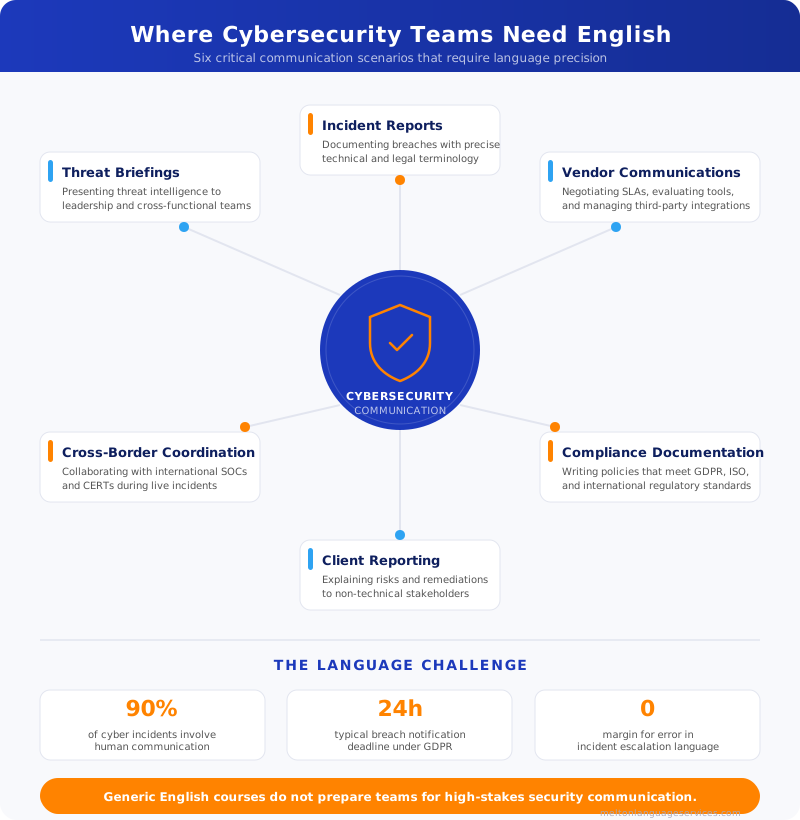
- Incident reports that get misread. A vague or ambiguous report can lead to the wrong remediation steps, delayed escalation, or a breakdown in trust with the affected client.
- Vendor calls that stall. When your team cannot articulate what they need from a technology partner, resolution times increase. In an active incident, that delay matters.
- Cross-border coordination that breaks down. Threat response often involves teams in multiple countries. If your people hesitate or struggle to communicate under pressure, the response slows down at exactly the wrong moment.
- Compliance documentation that misses the mark. Regulatory frameworks like NIS2 and ISO 27001 require precise language. Poor English in audit reports or policy documents can create compliance risks.
These are not hypothetical scenarios. They are daily realities for cybersecurity teams operating internationally.
The vocabulary challenge: technical terms vs. communication skills
Cybersecurity professionals often have strong technical vocabulary in English. They know the terms — phishing, lateral movement, privilege escalation, SIEM, SOC. That knowledge comes naturally from working with English-language tools and documentation every day.
But knowing technical terms is not the same as being able to communicate effectively. The real challenge is everything around those terms:
- Explaining a technical risk to a non-technical audience
- Writing an executive summary that a board member can act on
- Presenting findings in a way that is structured, clear, and persuasive
- Negotiating timelines and responsibilities with external partners
- Handling difficult conversations when something has gone wrong
This is where most cybersecurity professionals hit a wall. The technical English is there. The communication skills in English are not.
What generic business English misses for this sector
A standard business English course will teach your team how to write emails and make small talk in meetings. That is not what they need.
Cybersecurity professionals face communication challenges that are specific to their work: explaining risk under time pressure, writing for audiences with very different levels of technical knowledge, and coordinating with people they may never meet in person. The vocabulary, the tone, and the stakes are different from general business communication.
A coursebook unit on “telephoning” is not going to prepare someone to lead an incident bridge call with a client’s legal team and three external vendors.
Key communication scenarios for cybersecurity teams
Effective language training for this sector focuses on the situations your team actually faces:
- Incident reporting and escalation — writing clear, structured reports that non-technical stakeholders can understand and act on
- Client-facing communication — explaining security posture, risks, and recommendations without jargon overload
- Vendor and partner coordination — participating in technical calls, negotiating scope, and following up in writing
- Internal briefings — presenting threat assessments and project updates to leadership
- Compliance and documentation — producing policy documents, audit responses, and risk assessments that meet regulatory standards
- Conference participation — presenting research or case studies to an international audience
Each of these requires different language skills, different registers, and different levels of formality. Training that treats them all the same will not move the needle.
How ESP training works for technical professionals
English for Specific Purposes starts with your team’s actual work, not a textbook. The process typically looks like this:
Needs analysis. Before any training begins, the provider analyses what your team needs English for — what situations they face, where breakdowns happen, and what outcomes matter.
Custom materials. Training content is built around scenarios from your sector. Instead of generic role-plays, your team practises writing the kinds of reports they actually produce, handling the kinds of calls they actually take, and presenting the kinds of findings they actually deliver.
Targeted skill-building. Rather than working through grammar in sequence, training focuses on the specific language skills that will make the biggest difference — whether that is structuring an executive summary, managing a multi-party call, or writing under time pressure.
Ongoing adjustment. Good ESP training adapts as needs change. When your team faces a new type of communication challenge, the training can shift to address it.
Building confidence for high-stakes communication
For many cybersecurity professionals, the issue is not just language ability — it is confidence. They know their subject deeply but hesitate when they need to communicate it in English, especially under pressure or in front of senior stakeholders.
Tailored training builds that confidence because it mirrors real situations. When someone has practised explaining a breach scenario in a realistic exercise, doing it for real feels less daunting. When they have written dozens of executive summaries in training, the next one comes more naturally.
Your team already has the technical expertise. The right language training gives them the communication skills to match — so that expertise actually reaches the people who need to hear it.