English for Presentations: Structure, Phrases, Tips
Presenting in English when it is not your first language adds an extra layer of pressure. You are not just thinking about your content and your audience. You are also choosing words in real time, managing pronunciation, and trying to sound natural. The good news is that presentations follow predictable patterns, and learning a set of reliable phrases gives you a framework you can depend on every time.
Why structure matters more than fluency
A well-structured presentation in slightly imperfect English will always land better than a rambling one delivered with perfect grammar. Your audience needs to follow your logic. If they can see where you are going, they will forgive the occasional hesitation or unusual word choice.
Think of structure as your safety net. When nerves kick in, your structure keeps you on track.
The four-part presentation framework
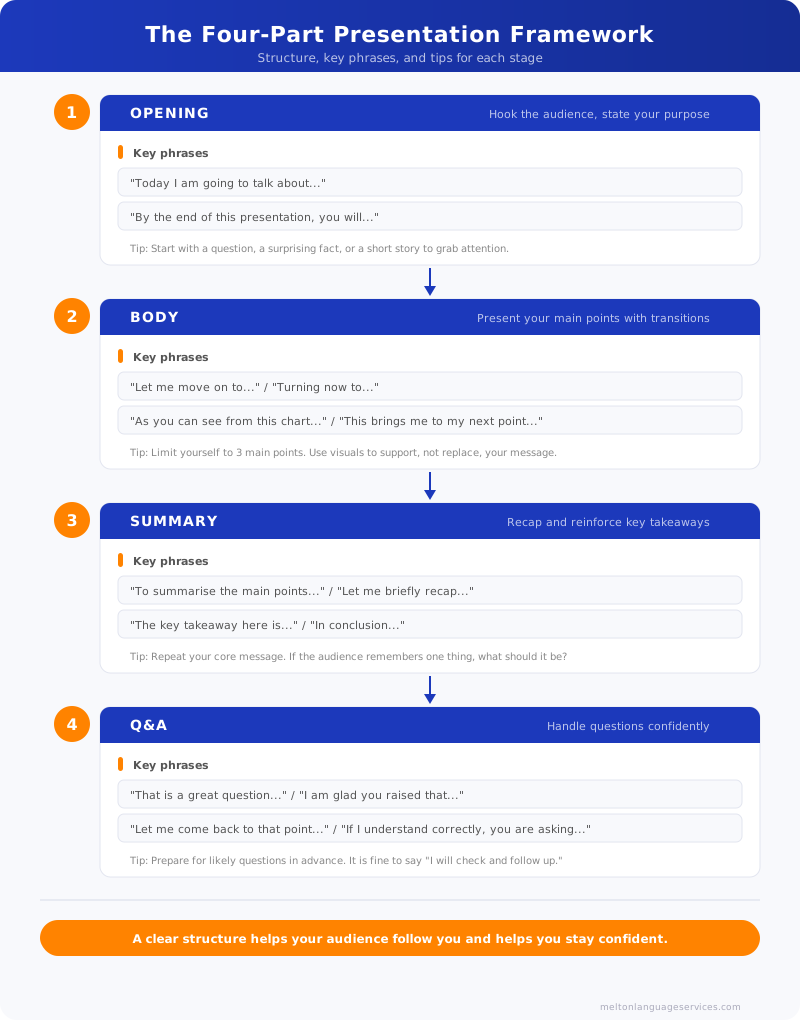
Most effective business presentations follow four stages: opening, body, summary, and Q&A. Each stage has its own set of go-to phrases.
1. Opening: Set the context
Your opening should accomplish three things in under 60 seconds: greet your audience, state your topic, and explain why it matters to them.
Greeting and introduction:
- “Good morning, everyone. Thank you for joining today.”
- “Hello, and welcome. My name is [name], and I work in [department/role].”
- “Thank you all for being here. I know your time is valuable, so let me get straight to it.”
Stating your purpose:
- “Today, I am going to talk about…”
- “The purpose of this presentation is to…”
- “I would like to walk you through…”
Explaining relevance:
- “This is important because…”
- “By the end of this session, you will have a clear picture of…”
- “This directly affects how we…”
Outlining the structure:
- “I have divided my presentation into three parts.”
- “First, I will cover… Then, I will move on to… Finally, we will look at…”
- “I will keep this to about 20 minutes and leave time for questions at the end.”
2. Body: Guide your audience through each section
The body is where most presenters lose their audience. The solution is signposting. Signposting means using short phrases that tell your audience where you are in the presentation and where you are going next.
Moving between sections:
- “Let us start with…”
- “Now, moving on to…”
- “That brings me to my next point.”
- “Let us now turn to…”
Emphasising key points:
- “The key takeaway here is…”
- “What I want to highlight is…”
- “This is particularly important because…”
- “I would like to draw your attention to…”
Referring to visuals:
- “As you can see on this slide…”
- “This chart shows…”
- “If you look at the figures on the right…”
- “The graph illustrates…”
Giving examples:
- “To give you a concrete example…”
- “For instance…”
- “Let me illustrate this with a real case.”
3. Summary: Reinforce your message
Never skip the summary. It is your chance to make sure your main points stick. Many presenters rush through this part, but it is actually the section your audience is most likely to remember.
Summarising:
- “To sum up…”
- “In summary, the three main points are…”
- “Let me briefly recap what we have covered.”
- “So, to wrap up…”
Stating a conclusion or recommendation:
- “Based on what I have presented, I would recommend…”
- “The data suggests that our next step should be…”
- “My recommendation is…”
Closing:
- “Thank you for your time and attention.”
- “I appreciate your attention. I am happy to take questions.”
- “That concludes my presentation. I will now open the floor for questions.”
4. Q&A: Handle questions with confidence
The Q&A section makes many non-native speakers nervous because it is unscripted. Having a few phrases ready takes the pressure off.
Inviting questions:
- “Does anyone have any questions?”
- “I am happy to answer any questions you may have.”
- “Please feel free to ask anything.”
Buying time when you need it:
- “That is a great question. Let me think about that for a moment.”
- “If I understand your question correctly, you are asking about…”
- “Could you clarify what you mean by…?”
When you do not know the answer:
- “I do not have that figure to hand, but I will follow up with you after the meeting.”
- “That is outside my area, but I can connect you with the right person.”
- “I would rather give you an accurate answer. Let me check and get back to you.”
Redirecting:
- “That is an interesting point. It might be worth discussing in more detail offline.”
- “I think that takes us slightly off topic, but I would be happy to cover it separately.”
Common mistakes to avoid
Reading from slides. Your slides should support your message, not be your script. Use bullet points or visuals, and speak to your audience, not to the screen.
Apologising for your English. Starting with “Sorry, my English is not very good” immediately undermines your credibility. Your audience is there for your content, not to judge your grammar.
Speaking too fast. When we are nervous, we speed up. Consciously slow down, especially during key points. Pausing briefly after an important statement gives it more weight.
Overloading slides with text. Keep slides visual. If your audience is reading dense text, they are not listening to you.
Skipping the summary. Even if you are running short on time, always deliver a brief recap. It is what your audience takes away.
Building confidence over time
Confidence in presenting does not come from memorising a script. It comes from preparation, repetition, and having a reliable set of phrases you can use without thinking. Here are some practical ways to build that confidence:
- Rehearse out loud. Practising silently in your head is not the same as saying the words. Rehearse at full volume, ideally standing up.
- Record yourself. Listening back reveals habits you would never notice otherwise, like filler words, pacing issues, or unclear transitions.
- Time your rehearsal. If you have 15 minutes, practise fitting your content into 12. This gives you breathing room.
- Prepare for likely questions. Think about what your audience will want to know and draft short answers in advance.
- Focus on communication, not perfection. Your goal is to be understood and to deliver value. That does not require flawless English.
Beyond the boardroom
Presentations are only one of the professional speaking contexts where language pressure shows up. Business dinners and informal client conversations carry a different kind of difficulty, with their own set of phrases and conventions. Our guide to restaurant English for business dinners and socialising covers the language that handles those moments.
Take your presentation skills further
Presenting in English is a skill that improves dramatically with guided practice and targeted feedback. At Melton Language Services, we design training programmes specifically for professionals who need to present, negotiate, and communicate in English with confidence. Whether you present to clients, stakeholders, or international teams, our approach focuses on the language you actually need.
Explore our business English programmes for teams or our individual English training if you want personalised coaching.