English Levels A1 to C2: CEFR, Cambridge, IELTS Compared
Updated: 21 September 2026
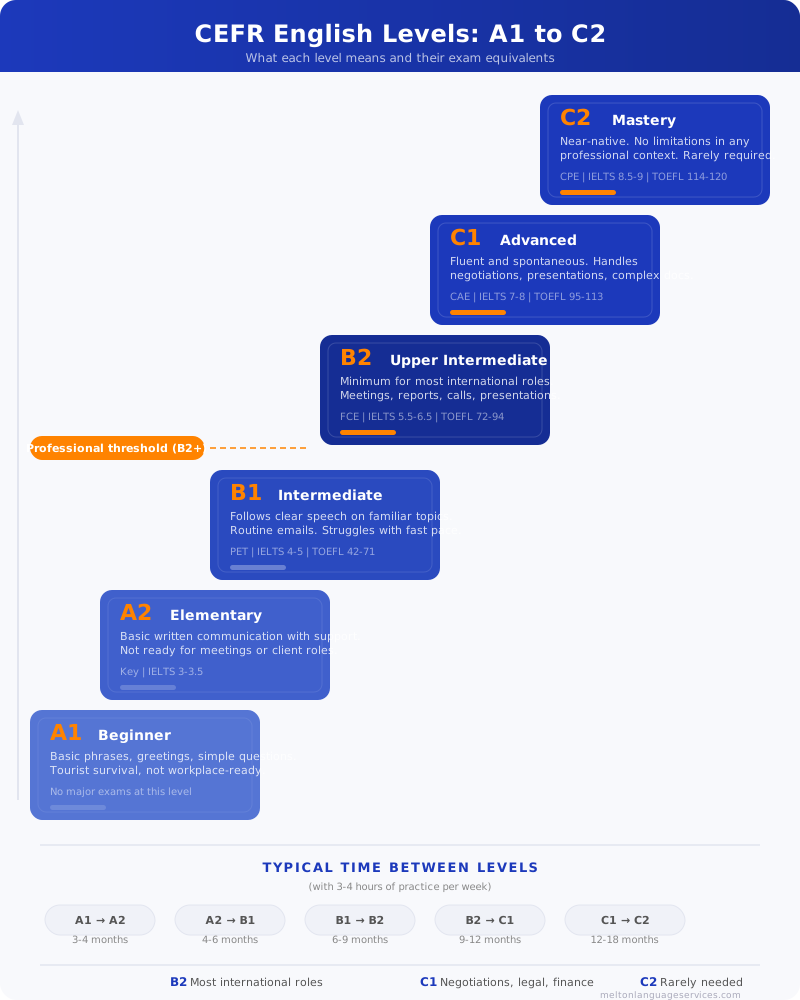
Job postings ask for “B2 minimum” or “C1 required.” Your CV lists a Cambridge certificate from five years ago. A colleague claims to be “advanced” but struggles in meetings. The CEFR framework (Common European Framework of Reference for Languages) is supposed to bring clarity to all of this by dividing language ability into six levels from A1 to C2. These levels are used across Europe and increasingly worldwide.
But what do these levels actually mean in practice? And which level do you genuinely need for your role? Here is a clear, practical guide.
The six CEFR levels explained
A1: Beginner
What you can do:
- Introduce yourself with basic phrases
- Ask and answer simple personal questions (name, nationality, job)
- Understand very slow, clear speech
- Read simple signs and short messages
In a professional context: Not suitable for any role requiring English communication. A1 means you can survive as a tourist, but not function in a workplace.
Equivalent exams: Cambridge A2 Key shows A1 as a stepping stone. Most exams start at A2 or above.
A2: Elementary
What you can do:
- Handle routine tasks and simple conversations
- Describe your daily routine and immediate environment
- Understand the main point of short, clear messages
- Write simple notes and emails on familiar topics
In a professional context: Can handle basic written communication (simple emails, forms) with support. Not ready for meetings, phone calls, or client-facing roles in English.
Equivalent exams: Cambridge A2 Key, IELTS band 3-3.5
B1: Intermediate
What you can do:
- Participate in conversations on familiar topics with reasonable fluency
- Understand the main points of clear speech on work, school, or leisure topics
- Write connected text on familiar subjects
- Handle most situations likely to arise while travelling
In a professional context: Can attend meetings with preparation and follow along if people speak clearly. Can write routine emails. May struggle with spontaneous conversation, technical topics, or fast-paced discussions.
Equivalent exams: Cambridge B1 Preliminary (PET), IELTS band 4-5, TOEFL iBT 42-71
B2: Upper Intermediate
What you can do:
- Interact with native speakers with a reasonable degree of fluency
- Understand the main ideas of complex text in your field
- Produce clear, detailed writing on a wide range of subjects
- Explain a viewpoint on a topical issue, giving advantages and disadvantages
In a professional context: This is the minimum level for most international roles. Can participate actively in meetings, write reports and proposals, handle phone calls, and present with preparation. May still make noticeable errors but communicates effectively.
Equivalent exams: Cambridge B2 First (FCE), IELTS band 5.5-6.5, TOEFL iBT 72-94, Duolingo English Test 100-115
C1: Advanced
What you can do:
- Express yourself fluently and spontaneously without obvious searching for words
- Use language flexibly for social, academic, and professional purposes
- Produce well-structured, detailed writing on complex subjects
- Understand a wide range of demanding, longer texts, including implicit meaning
In a professional context: Handles virtually all professional situations with confidence. Can negotiate, present to large audiences, write complex documents, and manage sensitive conversations. Errors are rare and do not impede communication.
Equivalent exams: Cambridge C1 Advanced (CAE), IELTS band 7-8, TOEFL iBT 95-113, Duolingo English Test 120-135
C2: Mastery
What you can do:
- Understand virtually everything heard or read
- Summarise information from different sources and reconstruct arguments coherently
- Express yourself spontaneously, very fluently, and precisely
- Differentiate finer shades of meaning even in complex situations
In a professional context: Near-native level. Can function in any English-speaking environment without limitation. Rarely needed as a formal requirement. Many native speakers would not test at C2 in all skills.
Equivalent exams: Cambridge C2 Proficiency (CPE), IELTS band 8.5-9, TOEFL iBT 114-120
What level do you actually need?
This is the question that matters most, and the answer depends entirely on your role.
B2 is enough for most jobs
If you need to:
- Participate in international meetings
- Write emails and reports
- Handle phone calls with clients
- Travel for business
B2 is sufficient. Most European companies set B2 as their requirement for international roles, and for good reason. It means you can communicate effectively even if you are not perfect.
C1 is needed for specific roles
If you need to:
- Lead negotiations in English
- Write legal or technical documents
- Manage English-speaking teams
- Present at conferences
- Work in roles where precise language matters (law, finance, diplomacy)
C1 is the target. The gap between B2 and C1 is significant in terms of nuance, flexibility, and independence.
C2 is rarely necessary
Very few roles genuinely require C2. If a job posting asks for C2, they probably mean C1. The distinction between C1 and C2 matters primarily for academic or literary work, not for business communication.
How employers use CEFR levels in job postings
HR teams often lift CEFR references from templates without checking what the role actually demands. This creates a common pattern: job postings that ask for C1 or C2 when B2 would do the work.
A few things happen inside recruitment that explain the drift:
- The person writing the job spec is not usually the person the hire will work with day to day. They pick the highest level they have heard of, on the assumption that more is safer.
- CEFR levels get treated as gates rather than descriptions. A candidate who tests at B2 in a live assessment can be filtered out on paper, even when the interviewer would rate them as ready.
- HR systems bucket levels differently across companies. “Advanced” in one internal grading maps to B2, while “advanced” in another maps to C1. The same word means different things across the same industry.
If you are on the hiring side, describe the tasks the role involves and let the level follow. “Runs weekly client calls in English and writes proposals” is more useful than “C1 required.” Candidates self-select more accurately when they can see the actual work.
If you are on the candidate side, apply for roles that sit one band above your tested level. Job postings tend to overshoot, and interviewers reward candidates who can demonstrate the specific tasks the role needs, whether or not their certificate matches the stated line.
Common misconceptions about CEFR
Self-assessed level rarely matches tested level. People typically rate themselves one band above where they actually test. A confident B1 speaker will describe themselves as B2. A B2 speaker will call themselves fluent and mean C1. Testing exists to remove that gap.
“Advanced” on a CV usually means B2, not C1. The word “advanced” gets applied to anyone who has studied English past school. Recruiters know this and discount it. If your CV lists “advanced English,” expect an interview to test whether you can actually operate at C1.
B2 is where most learners plateau. Reaching B2 is often the goal of school-based English study. Once you can function in most work situations, the pressure to keep progressing drops. Without a specific reason to push further, such as a role that demands C1 or living in an English-speaking environment, progress slows and can stop entirely.
A certificate from ten years ago does not describe your current level. Language ability is use-based. Someone who tested at C1 in 2015 and has not worked in English since may operate at B2 today. The certificate documents what you did, not what you do.
C2 is not the goal for most professionals. C2 tests literary and academic register alongside professional register. Chasing C2 as a work target usually means spending time on skills your role will never use.
How to actually test your CEFR level
Self-assessment tools give you a starting estimate. The British Council, Cambridge, and the EU each publish free online tests that place you within one or two bands. They are useful for orientation but not credible enough to put on a CV.
For a formal, employer-recognised level, three options cover most professional needs:
- Cambridge Linguaskill is an online, adaptive test scored by AI. It gives you a CEFR level for reading, listening, writing, and speaking in about two hours. Employers across Europe use it for internal grading and recruitment.
- British Council Aptis is a similar online assessment aimed at organisations. Results come back within 48 hours and cover all four skills. It is common in public-sector and NGO hiring.
- Cambridge B2 First, C1 Advanced, or C2 Proficiency is the traditional route. These exams take longer to schedule, but the certificate does not expire and carries the strongest recognition across universities and immigration processes.
When to invest in a formal exam: if a specific job, visa, or university programme lists a required certificate, or if you want a permanent record of your level. Otherwise, an internal placement test with a training provider will tell you what you need to know, and it is what most companies use before starting a training programme.
How long does it take to move between levels?
As a rough guide, with regular practice (three to four hours per week):
- A1 to A2: 3-4 months
- A2 to B1: 4-6 months
- B1 to B2: 6-9 months
- B2 to C1: 9-12 months
- C1 to C2: 12-18 months (and many people plateau here)
These timelines vary enormously based on your native language, learning environment, motivation, and how much English you use in daily life.
CEFR and exam score equivalents at a glance
| CEFR | Cambridge | IELTS | TOEFL iBT | Duolingo |
|---|---|---|---|---|
| A2 | Key | 3-3.5 | - | 65-85 |
| B1 | Preliminary | 4-5 | 42-71 | 85-100 |
| B2 | First | 5.5-6.5 | 72-94 | 100-115 |
| C1 | Advanced | 7-8 | 95-113 | 120-135 |
| C2 | Proficiency | 8.5-9 | 114-120 | 140-160 |
A note on digital credentials
The landscape of English certification is evolving. The Duolingo English Test has gained significant acceptance since 2020, with over 5,000 institutions now recognising it. Linguaskill from Cambridge offers quick, AI-scored assessments that many European employers use for recruitment. TOEIC remains widely used for workplace English assessment, particularly in France, Japan, and South Korea.
When choosing which exam to take, consider what your target audience recognises. A Cambridge certificate carries strong weight across Europe. IELTS and TOEFL are standard for university admissions. Duolingo and Linguaskill are increasingly accepted for employment contexts where a quick, reliable assessment is needed.
Key takeaways
- CEFR provides a standardised way to describe language ability across Europe
- B2 is the practical minimum for most international professional roles
- C1 is needed for roles requiring nuanced, high-stakes communication
- C2 is rarely required and often overstated as a job requirement
- Digital assessment options like Linguaskill and Duolingo are expanding access to certification
- Focus on reaching the level your role actually demands, not the highest possible level
Understanding where you are and where you need to be is the first step toward targeted, effective language development.
FAQ
What is the difference between B2 and C1 English?
B2 is the level at which you can hold your own in most professional situations. You can run meetings, write emails, give presentations, and follow standard business conversation, even if some nuance is lost. C1 is the level at which language stops being a barrier. You can negotiate, persuade, handle difficult conversations, and pick up tone and intent. B2 is operational. C1 is fluent.
What CEFR level is considered fluent in English?
Fluency is usually associated with C1 or C2. C1 means you can use English flexibly and effectively for social, academic, and professional purposes, including handling complex topics. C2 is mastery, equivalent to a highly educated native speaker. In practice, most fluent professionals operate at C1. C2 is rarely required for work and is often overstated as a job requirement.
Which English level do I need for work?
For most international roles, B2 is the practical minimum. It lets you function in meetings, emails, and standard business exchanges. Roles that involve negotiation, leadership, persuasion, or technical writing in English typically need C1. Roles that are mostly receptive, such as reading documentation or following written instructions, can work at B1, but speaking and writing become bottlenecks quickly above that threshold.