How to Choose a Language Training Provider for Your Company
Choosing a language training provider is one of those decisions that looks straightforward until you realise how much variation exists between providers. The wrong choice does not just waste budget. It wastes your team’s time and damages their confidence that the company takes their development seriously.
Most HR and L&D managers evaluate providers the same way: compare prices, check availability, pick the one that fits the calendar. That approach misses the questions that actually determine whether training delivers results.
Why this decision matters more than you think
Language training is one of the few investments that touches every department. When it works, your team communicates more effectively with clients, partners, and colleagues across borders. When it does not work, people sit through sessions they find irrelevant, stop attending, and the programme quietly dies.
The difference between those two outcomes rarely comes down to the learners. It comes down to the provider.
The difference between a language school and a training partner
A language school sells courses. A training partner builds programmes around your business.
The distinction matters. A school will offer you a coursebook, a schedule, and a teacher. A training partner will ask about your team’s roles, the situations where communication breaks down, and the specific outcomes you need. They will design materials around your sector and adjust the programme as your needs change.
If a provider cannot explain how they will tailor training to your company, they are selling a course, not a solution.
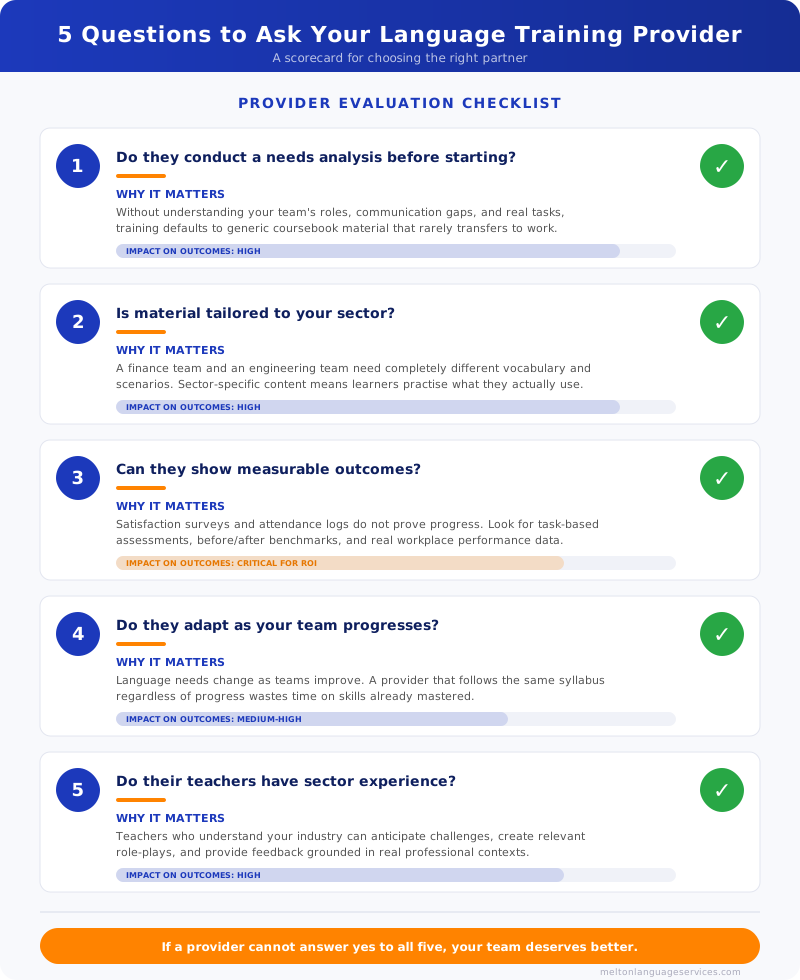
Five questions to ask every provider
These will tell you more than any sales presentation:
-
How do you assess our team’s needs before training starts? Look for more than a placement test. A proper assessment involves understanding job roles, communication contexts, and business objectives.
-
Do you create materials specific to our sector? If the answer involves a coursebook series, that is your signal to keep looking.
-
How do you measure progress? Vague answers about “improvement” or “student satisfaction” are not enough. You want specific benchmarks tied to workplace performance.
-
What happens if the programme is not working? Good providers have a plan for this. They monitor engagement, gather feedback, and adjust. They do not just keep delivering the same sessions regardless.
-
Can you show us examples from similar companies? Experience in your sector is not essential, but the ability to demonstrate how they have adapted training for different industries is.
Red flags that signal a generic approach
Walk away if a provider:
- Offers the same programme to every client regardless of industry
- Cannot describe their needs analysis process in detail
- Measures success only through attendance or satisfaction surveys
- Uses the same coursebook for your finance team and their retail clients
- Has no mechanism for adjusting the programme once it starts
Generic training produces generic results. Your team deserves better.
What a proper needs analysis looks like
A serious needs analysis is not a formality. It should include:
- Conversations with managers about where language gaps create real problems
- Review of workplace materials — the emails, reports, and presentations your team actually produces
- Individual assessments that go beyond grammar to test the specific skills each person needs
- Clear objective-setting so everyone agrees on what success looks like before training begins
This process takes time. Providers who skip it or rush through it are telling you something about how they will handle the rest of the programme.
How to evaluate after the first quarter
Three months is enough to see whether a programme has traction. Ask yourself:
- Are attendance rates holding steady or declining?
- Can participants point to specific situations where they have applied what they learned?
- Has the provider made any adjustments based on feedback?
- Are managers noticing differences in their team’s communication?
If attendance is dropping and nobody can name a concrete improvement, the programme needs to change — or the provider does.
The cost question: price vs. value
Cheaper training is not cheaper if half your team stops attending by month three. The real cost is what you pay per hour of training that actually gets used and applied.
A provider that charges more but delivers tailored content, tracks outcomes, and keeps your team engaged will cost less in the long run than a bargain option that delivers irrelevant material to an empty classroom.
Ask providers to explain their pricing in terms of what is included: needs analysis, custom materials, progress reporting, programme adjustments. Then compare on value, not on hourly rate alone.
Making the final decision
The best language training providers operate more like consultants than teachers. They understand that your goal is not “English lessons” or “Spanish classes.” Your goal is a team that can communicate effectively in the languages your business requires.
Look for a provider that asks good questions, builds programmes around your specific needs, and measures what matters. That approach — Language for Specific Purposes — is what separates training that delivers from training that just fills a timetable.
Your team’s time is valuable. Spend it on training that earns its place in their calendar.