How to Negotiate in English: Key Phrases and Strategies
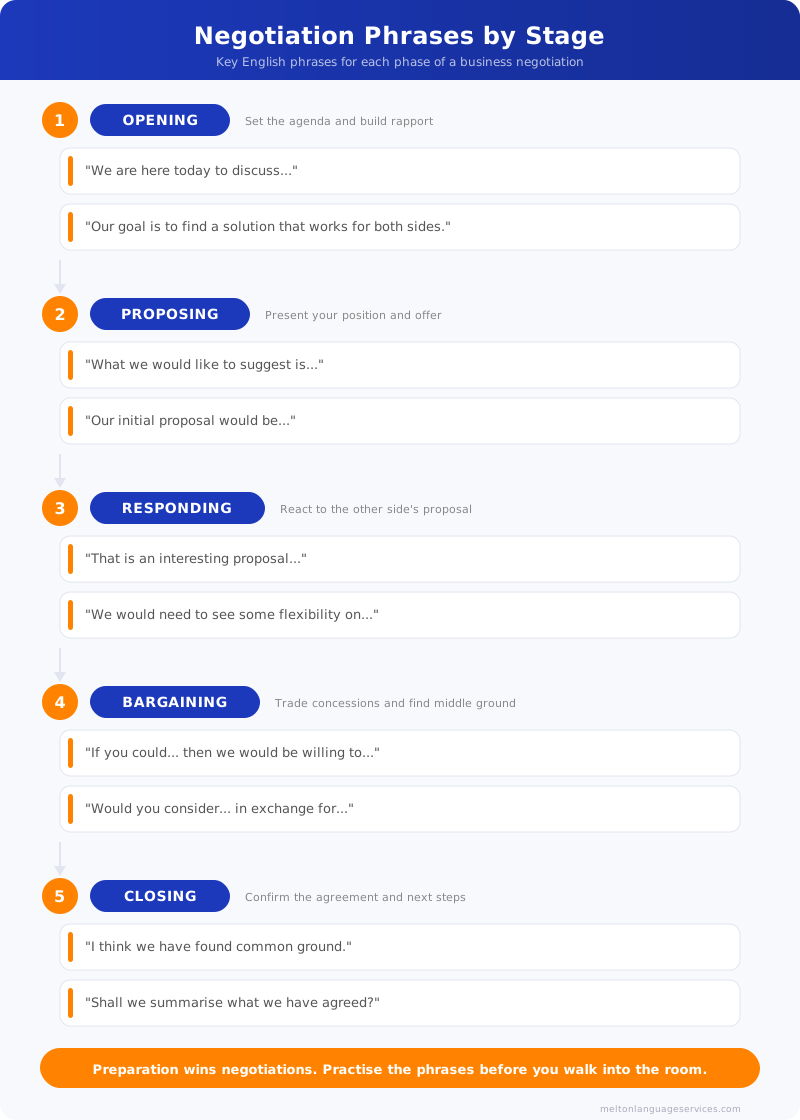
Negotiating in any language requires confidence, clarity, and the ability to read the room. When you are negotiating in English as a second language, you also need a reliable set of phrases that let you focus on strategy rather than searching for words. This guide covers the key language for each stage of a business negotiation, from opening the discussion to closing the deal.
The language of negotiation: why it matters
In a negotiation, how you say something is just as important as what you say. The difference between “We want a lower price” and “We were hoping there might be some flexibility on price” is not just politeness. It is strategy. The second version keeps the door open, avoids putting the other side on the defensive, and gives you more room to manoeuvre.
English-language negotiations tend to rely heavily on indirect, diplomatic language. Understanding these patterns gives you a significant advantage, even if your grammar is not perfect.
Stage 1: Opening the negotiation
The opening sets the tone. You want to be professional, positive, and clear about why you are there.
Starting the conversation:
- “Thank you for making time for this meeting.”
- “We appreciate the opportunity to discuss this with you.”
- “Shall we get started?”
Stating your purpose:
- “The main thing we would like to discuss today is…”
- “We are here to talk about the terms of…”
- “Our goal today is to find an arrangement that works for both sides.”
Setting the agenda:
- “I suggest we start with pricing, then move on to timelines. Does that work for you?”
- “There are three main areas I would like to cover today.”
- “Would it be helpful to outline the key points first?”
Stage 2: Making proposals
When you put a proposal on the table, the language you use signals whether it is a firm position or a starting point for discussion.
Making a proposal:
- “We would like to propose…”
- “What we have in mind is…”
- “Our suggestion would be…”
- “We were thinking along the lines of…”
Explaining your reasoning:
- “The reason we are suggesting this is…”
- “This is based on…”
- “We believe this is fair because…”
- “If you look at the market rate, you will see that…”
Softening a proposal:
- “This is just an initial idea, of course.”
- “We are open to discussing the details.”
- “This is our starting position, and we are happy to hear your thoughts.”
Stage 3: Responding to proposals
How you respond to the other side’s proposals determines the direction of the negotiation. You need language for agreeing, partially agreeing, and disagreeing without shutting down the conversation.
Agreeing:
- “That sounds reasonable.”
- “We are happy with that.”
- “That works for us.”
Partially agreeing:
- “We agree in principle, but we would need to adjust…”
- “That is a good starting point. However, we have some concerns about…”
- “We can see the logic behind that, although…”
Disagreeing diplomatically:
- “I understand your position, but we see it differently.”
- “That would be difficult for us because…”
- “I am afraid that does not quite work on our end.”
- “We would struggle with that, to be honest.”
Asking for clarification:
- “Could you walk us through the reasoning behind that?”
- “When you say [X], do you mean…?”
- “Could you be more specific about…?”
Stage 4: Bargaining and making concessions
This is the core of any negotiation. The language here needs to show willingness to move while protecting your key interests.
Making a counter-proposal:
- “What if we were to…?”
- “Would you consider…?”
- “An alternative might be…”
- “How about we approach it this way instead?”
Making concessions:
- “We are willing to be flexible on [X] if you can move on [Y].”
- “We could agree to that, provided that…”
- “If you can meet us on the delivery timeline, we can look at the pricing again.”
- “As a gesture of goodwill, we are prepared to…”
Setting conditions:
- “We would be comfortable with that on the condition that…”
- “That would only work if…”
- “We can agree to this, but we would need…”
Holding firm:
- “I understand your position, but this is something we cannot move on.”
- “That is really our best offer.”
- “We have already made significant concessions on this point.”
- “This is a priority for us, and we need it to stay as it is.”
Stage 5: Closing the deal
Closing requires clear language to confirm what has been agreed and what happens next.
Checking agreement:
- “So, just to confirm, we have agreed that…”
- “Let me summarise what we have discussed.”
- “Are we all on the same page regarding…?”
Confirming next steps:
- “We will send over a written summary by [date].”
- “The next step would be to draft the contract.”
- “I suggest we schedule a follow-up call to finalise the details.”
Closing positively:
- “I think we have reached a good agreement.”
- “Thank you for a productive discussion.”
- “We are pleased with the outcome and look forward to working together.”
Useful strategies beyond the phrases
Knowing the right phrases is essential, but effective negotiation also depends on a few broader strategies.
Prepare your key phrases in advance. Before any important negotiation, write down the specific proposals, conditions, and concessions you expect to make. Having the English ready removes hesitation.
Listen more than you speak. In a second language, there is a temptation to fill silences. Resist it. Silence after a proposal puts gentle pressure on the other side and gives you time to think.
Use “we” instead of “I.” Framing your position as a team decision (“We would need…” rather than “I want…”) makes it harder for the other side to take things personally and signals that the decision is not yours alone.
Paraphrase what the other side says. Repeating their points in your own words (“So, if I understand correctly, you are saying…”) shows you are listening and gives you time to formulate your response.
Do not rush to fill gaps. If you need a moment to think, use bridging phrases: “That is an interesting point. Let me consider that for a moment.” This is perfectly normal, even for native speakers.
Know your walk-away point. Before you start, decide the minimum you will accept. Having this clear in your mind reduces the risk of agreeing to something under pressure that you later regret.
Strengthen your negotiation skills in English
Negotiating well in English is not just about vocabulary. It is about using the right tone, reading signals, and responding with confidence. At Melton Language Services, we train professionals to handle high-stakes conversations in English, from contract negotiations to partnership discussions. Our programmes are built around the real situations you face at work, not textbook dialogues.
Explore our business English programmes for teams or our individual English training for focused, one-to-one coaching.