How to Prepare for a Job Interview in English
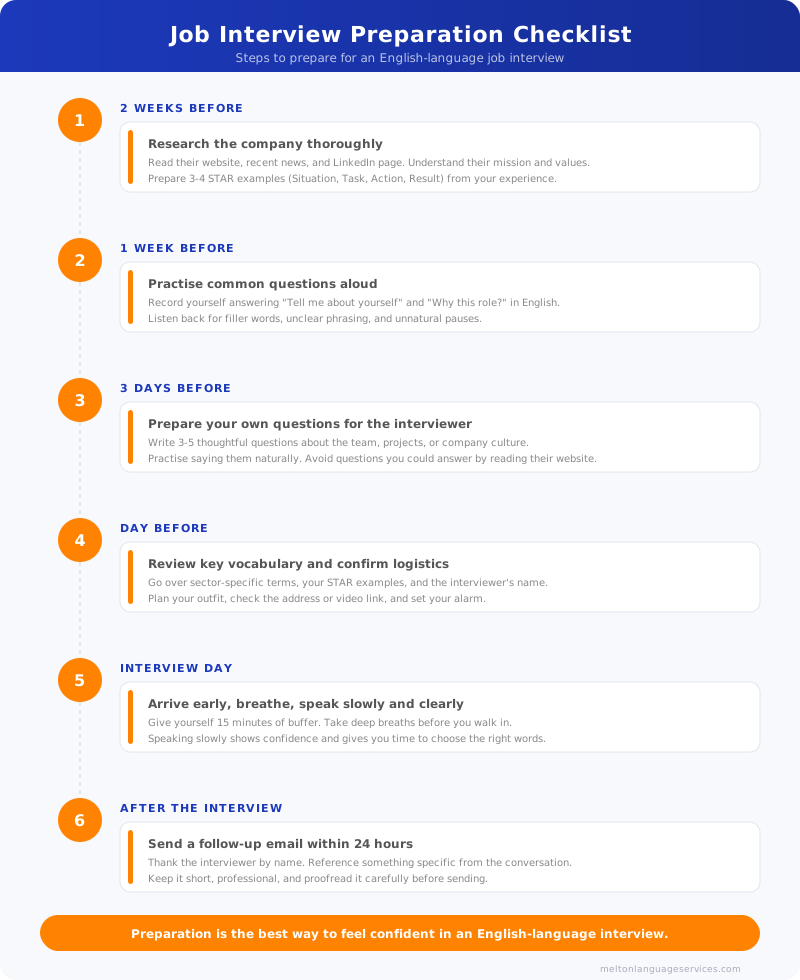
Job interviews are stressful enough in your first language. Doing one in English adds another layer of challenge. But with the right preparation, you can walk into the room (or join the video call) feeling confident and ready to show what you can do.
This guide covers practical strategies and useful phrases to help you prepare for a job interview in English, whether it is your first time interviewing in English or you want to sharpen your performance.
Before the interview: preparation that makes a difference
Research the company and role
This applies in any language, but it is especially important when interviewing in English. Researching the company gives you vocabulary and talking points you can prepare in advance. Read:
- The company’s website, especially the About and Careers pages
- Recent news articles or press releases about the company
- The job description in detail, noting key responsibilities and requirements
- LinkedIn profiles of the interviewers, if you know who they are
Write down key terms and phrases from these sources. Practise saying them out loud so they feel natural when you use them in the interview.
Prepare answers to common questions
Most interviews follow a predictable structure. Preparing answers to these common questions will give you a strong foundation:
“Tell me about yourself.” Keep it professional and concise. Structure it as: current role, relevant experience, and why you are interested in this position.
Example: “I’m currently a project manager at a technology consultancy, where I lead a team of eight. Over the past five years, I’ve managed projects in the financial services sector, mostly focused on digital transformation. I’m looking for a new challenge, and your focus on sustainability technology is what drew me to this role.”
“Why do you want to work here?” Connect your skills and interests to something specific about the company.
Example: “I’ve been following your expansion into the European market, and I think my experience working across different European regulatory frameworks would be a strong fit for the challenges you’re facing.”
“What are your strengths?” Choose strengths that are relevant to the role and give a brief example to support each one.
Example: “I’d say one of my key strengths is managing stakeholder expectations. In my current role, I work with clients across four countries, each with different priorities, and I’ve learned how to find solutions that satisfy everyone.”
“What is your biggest weakness?” Be honest but strategic. Choose a genuine area for improvement and explain what you are doing about it.
Example: “I sometimes spend too much time making sure everything is perfect before sharing it with the team. I’ve been working on this by setting deadlines for first drafts and getting feedback earlier in the process.”
“Where do you see yourself in five years?” Show ambition that aligns with the company’s direction.
Example: “I’d like to be leading a regional team and contributing to the company’s strategy in Southern Europe. I see this role as a strong step towards that.”
Practise the STAR method
For behavioural questions (“Tell me about a time when…”), the STAR method keeps your answers structured and clear:
- Situation: Set the scene briefly
- Task: What was your responsibility?
- Action: What did you do?
- Result: What was the outcome?
Example question: “Tell me about a time you had to deal with a difficult client.”
Example answer: “In my previous role, we had a client who was unhappy with the timeline for a deliverable. My task was to manage their expectations while keeping the project on track. I arranged a call to listen to their concerns, then proposed a revised schedule with interim milestones so they could see progress along the way. The result was that they agreed to the new timeline and actually extended the contract by six months.”
During the interview: communication strategies
Speak at a natural pace
When you are nervous, it is tempting to rush. Speaking too fast in a second language often leads to stumbling over words or losing your thread. Slow down slightly, pause between ideas, and give yourself time to think.
It is fine to ask for clarification
If you do not understand a question, it is much better to ask than to guess. Use phrases like:
- “Could you repeat that, please?”
- “I’m not sure I understood the question. Could you rephrase it?”
- “Do you mean…?”
- “Just to make sure I understand, are you asking about…?”
Asking for clarification is not a sign of weakness. It shows you care about giving a relevant answer.
Use linking phrases to buy thinking time
If you need a moment to gather your thoughts, these phrases sound natural and professional:
- “That’s a great question. Let me think about that for a moment.”
- “There are a few things I could mention here. Let me start with…”
- “I think the best example would be from my time at…”
Avoid filler words
Try to minimise “um,” “uh,” “like,” and “you know.” A brief pause is always better than filling silence with filler words. Interviewers will not notice a short pause, but they will notice excessive fillers.
Key phrases for different parts of the interview
Talking about your experience
- “In my current role, I’m responsible for…”
- “I’ve been working in [sector] for [X] years.”
- “One of my main achievements was…”
- “I led a project that resulted in…”
- “I have experience in [skill/area], which I developed while…”
Explaining why you want the role
- “What attracted me to this role is…”
- “I’m particularly interested in your work on…”
- “This position aligns well with my experience in…”
- “I’m looking for an opportunity to…”
Asking questions at the end
- “Could you tell me more about the team I’d be working with?”
- “What does a typical day look like in this role?”
- “What are the main challenges the team is facing right now?”
- “How do you measure success in this position?”
- “What are the next steps in the process?”
Always prepare at least two or three questions to ask. It shows genuine interest and gives you useful information.
Common mistakes to avoid
- Memorising answers word for word: Prepare key points, not scripts. Recited answers sound unnatural.
- Apologising for your English: Do not start with “Sorry, my English is not very good.” Your English is good enough to interview in, so let your answers speak for themselves.
- Using overly casual language: Even if the interviewer is friendly, keep your language professional. Avoid slang and very informal expressions.
- Forgetting to listen: Interviews are conversations. Listen carefully to what the interviewer says and respond to their actual questions, not the questions you prepared for.
- Not preparing examples: Vague answers are unconvincing in any language. Have specific examples ready for your key strengths and experiences.
After the interview
Send a brief thank-you email within 24 hours. Keep it short and professional:
“Dear [Name], thank you for taking the time to meet with me today. I enjoyed learning more about the [role title] position and the team’s work on [specific project or topic discussed]. I’m very interested in the opportunity and look forward to hearing from you. Best regards, [Your name].”
Building long-term confidence
Interview skills improve with practice. If you know you will be interviewing in English, it is worth investing in targeted preparation. Record yourself answering practice questions, work with a teacher who can give you feedback on your language and delivery, and build your professional vocabulary in the weeks before the interview.
At Melton Language Services, we work with professionals across Europe who need English for career-defining moments like job interviews, presentations, and negotiations. Our one-to-one programmes are tailored to your specific goals, so you can focus on exactly what you need. If you have an interview coming up and want targeted preparation, get in touch.