How to Write an RFP for Language Training
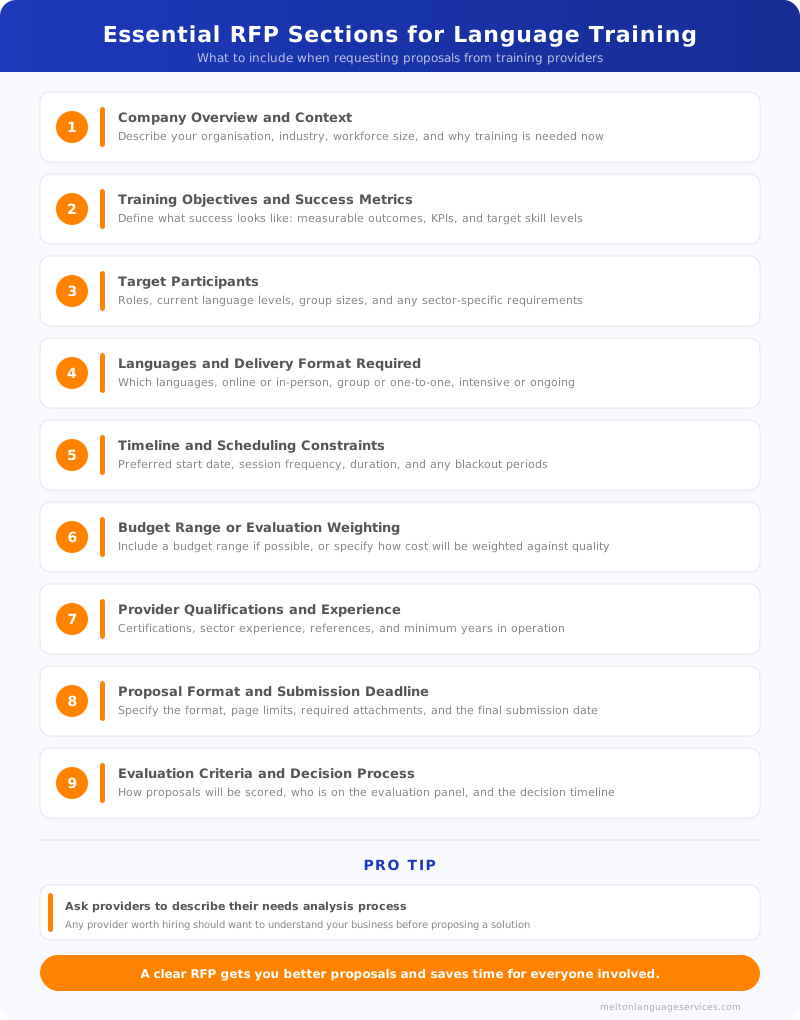
If your organisation is planning to invest in language training for employees, writing a clear RFP (Request for Proposal) is one of the most important steps you can take. A well-structured RFP saves time, attracts better proposals from providers, and gives you a solid framework for comparing options.
Yet many HR and procurement teams find themselves writing RFPs that are either too vague or too rigid. Too vague, and you get generic proposals that all look the same. Too rigid, and you may rule out providers whose methodology would actually be a better fit.
This guide walks you through the key sections every language training RFP should include, with practical advice on what to ask for and why.
Why the RFP matters more than you think
Language training is not a commodity purchase. The difference between a provider that delivers real results and one that simply fills a timetable is significant. A good RFP forces you to clarify your own goals before you start evaluating external options. It also signals to providers that you are a serious buyer who values quality, which tends to attract better proposals.
Essential sections for your language training RFP
1. Company background and context
Give providers enough context to understand your situation. This does not need to be lengthy, but it should cover:
- Your industry and what your teams do day to day
- The languages your employees currently work in
- Why you are investing in language training now (expansion, client requirements, internal communication gaps)
- Any previous language training programmes and what worked or did not work
2. Objectives and success criteria
This is where many RFPs fall short. Saying “improve employees’ English” is not specific enough. Consider what success actually looks like:
- Do employees need to reach a specific CEFR level?
- Should they be able to lead meetings, write reports, or negotiate in the target language?
- Are you measuring success through formal assessments, manager feedback, or observable workplace performance?
Be clear about the skills that matter most. A programme focused on written communication for legal teams looks very different from one focused on spoken fluency for a sales team.
3. Scope and logistics
Outline the practical details:
- Number of participants: How many employees and at what levels?
- Languages required: English, Spanish, French, Arabic, or others?
- Format preferences: In-person, online, hybrid, or a combination?
- Location: If in-person sessions are required, where?
- Schedule: During working hours? Before or after? How many hours per week?
- Duration: A fixed-term programme or ongoing?
- Start date: When do you need training to begin?
4. Methodology questions
This section separates providers who follow a generic syllabus from those who build something tailored to your organisation. Ask providers to explain:
- How they assess employees’ current levels and learning needs
- Whether content is customised to your industry and job roles
- How they handle mixed-level groups
- What materials they use and whether they create sector-specific content
- How they keep learners engaged over time
- Whether they incorporate real workplace tasks into sessions (emails, presentations, reports your employees actually produce)
5. Teacher qualifications and experience
The quality of teachers is often the single biggest factor in programme success. Ask for:
- Minimum qualifications (CELTA, DELTA, or equivalent)
- Experience teaching in corporate or professional settings
- Experience with your industry or sector
- How teachers are matched to groups
- What happens if a teacher is not a good fit
6. Assessment and reporting
You need to track progress, both for programme management and to justify the investment internally. Ask providers to describe:
- Initial placement testing
- How often progress is measured and reported
- The format of progress reports (and whether they can be shared with managers and HR)
- Whether they offer end-of-programme assessments aligned to CEFR or other recognised frameworks
7. Technology and platform
If training will be delivered online or in a hybrid format, you need to understand the technology involved:
- What platform do they use for live sessions?
- Is there a learning management system (LMS) for self-study or homework?
- Can the platform integrate with your existing HR systems?
- How is attendance tracked?
8. Pricing structure
Ask for a clear breakdown. Language training can be priced per hour, per participant, per group, or as a flat programme fee. Make sure you understand:
- What is included in the quoted price (materials, assessments, reporting)
- Whether there are minimum commitment periods
- Cancellation and rescheduling policies
- Any additional costs for customisation or content development
9. References and case studies
Ask for references from organisations of a similar size or in a similar sector. If possible, request:
- A case study showing measurable outcomes
- Contact details for a current or recent client you can speak with
- Examples of customised materials they have created for other organisations
Evaluation criteria: what to weight most heavily
When reviewing proposals, consider weighting your evaluation criteria roughly as follows:
- Methodology and customisation (30%): Can the provider build a programme around your specific needs, or are they offering a one-size-fits-all solution?
- Teacher quality (25%): Qualifications and relevant experience matter enormously.
- Track record and references (20%): Proven results in similar contexts.
- Reporting and accountability (15%): How will you know the programme is working?
- Price (10%): Important, but the cheapest option rarely delivers the best return.
Common mistakes to avoid
- Not involving end users: Talk to the employees who will actually receive training. Their input on scheduling, format preferences, and what they struggle with daily will make your RFP stronger.
- Focusing only on price: Language training is an investment in your team’s performance. Choosing the cheapest provider often leads to high dropout rates and poor outcomes.
- Being too prescriptive about methodology: If you dictate exactly how training should be delivered, you limit providers’ ability to propose creative, effective solutions.
- Skipping the pilot phase: Ask whether providers offer a trial period or pilot group before committing to a full rollout.
A final note on finding the right fit
The best language training programmes are built around the way your teams actually work. If your employees spend their days writing technical reports, the training should reflect that. If they are preparing for international negotiations, the content should prepare them for those specific scenarios.
At Melton Language Services, we specialise in building tailored language programmes for organisations across Europe. With over 25 years of experience in English, Spanish, French, and Arabic, we focus on language for specific purposes rather than generic coursebook material. If you are putting together an RFP and want to discuss what good language training looks like, get in touch.