What Makes ESP Different from General English?
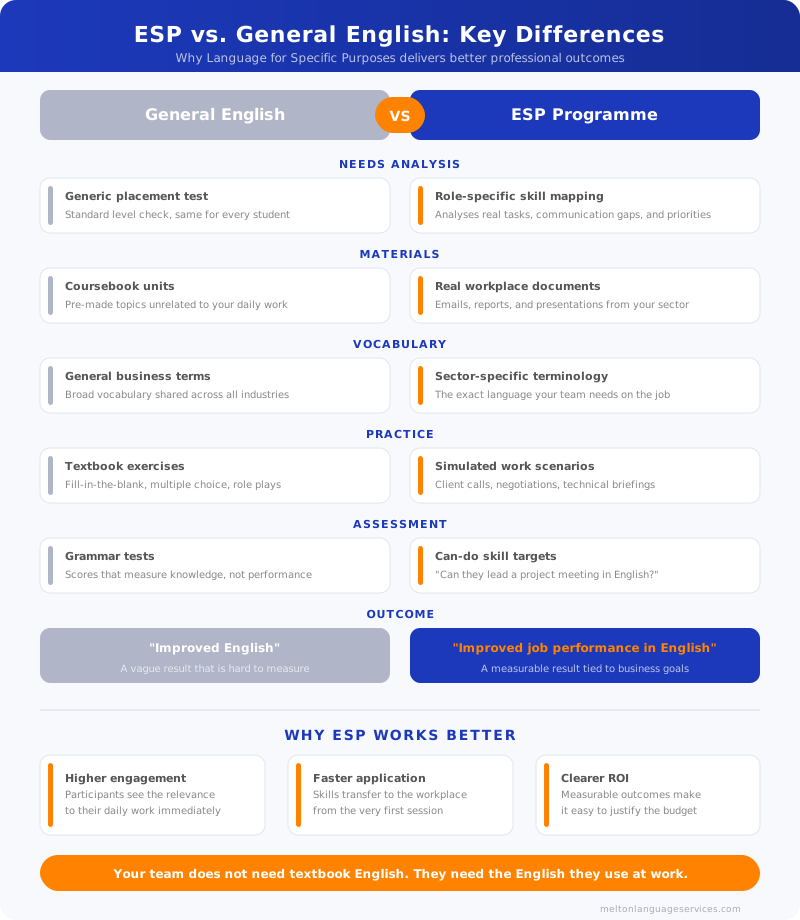
If you have ever sat through an English class where you practised ordering food at a restaurant when what you actually needed was to present quarterly results to your board, you already understand the problem that English for Specific Purposes (ESP) was designed to solve.
ESP is an approach to language teaching that builds the course around the learner’s professional context. Instead of working through a general textbook chapter by chapter, ESP programmes focus on the language, tasks, and communication skills that learners actually need in their jobs.
General English vs ESP: the core difference
General English courses follow a broad syllabus. They cover a wide range of grammar, vocabulary, and skills designed to be useful in everyday life. This works well for beginners who need a solid foundation or for people learning English for travel and social situations.
ESP takes a different starting point. It asks: what does this person need to do in English, and what language do they need to do it well?
A general English course might teach the vocabulary of food, travel, and hobbies at B1 level. An ESP programme for the same B1 learner who works in procurement would focus on writing specifications, negotiating with suppliers, and understanding contract terms.
Both approaches teach English. But ESP teaches the English that matters most for each learner’s professional life.
How ESP works in practice
Needs analysis comes first
Every ESP programme starts with a needs analysis. This is not just a placement test to determine level. It examines:
- What the learner does at work every day
- Which tasks they perform in English (or need to start performing in English)
- What communication challenges they face
- What their short-term and long-term goals are
- What sectors and topics their work involves
This analysis shapes the entire course. Two B2-level learners in different industries will follow very different programmes.
Content mirrors the workplace
ESP materials are drawn from the learner’s real professional world. Instead of generic business case studies, you might work with:
- Emails and reports similar to ones you actually write
- Vocabulary specific to your sector (finance, engineering, healthcare, legal, technology)
- Meeting formats and presentation structures used in your organisation
- Industry publications and documents relevant to your role
This does not mean every session is dry and technical. Good ESP teachers know how to balance sector-specific content with engaging activities that build confidence and fluency.
Skills are prioritised, not treated equally
In general English, the four skills (reading, writing, listening, speaking) typically receive roughly equal attention across a course. ESP prioritises the skills each learner needs most.
A software developer who mainly reads technical documentation and writes code comments in English will spend more time on reading and writing. A sales manager who spends most of the day on calls with international clients will focus more on listening and speaking.
Grammar is taught in context
ESP does not ignore grammar. But instead of working through grammar topics in the traditional textbook order, ESP introduces grammar when it is relevant to the tasks being practised.
If you are learning to write recommendation reports, you will work on conditionals and modals because those structures appear constantly in that type of writing. If you are preparing for negotiations, you will practise question forms, softening language, and conditional offers because those are the grammar patterns that matter in that context.
Who benefits most from ESP?
ESP is especially effective for:
- Professionals at B1 level and above who have a foundation in English but need to use it for specific work tasks
- Teams in specialised sectors where generic business English does not cover the vocabulary and communication patterns they need (healthcare, engineering, legal, defence, finance, energy)
- Employees preparing for specific events such as international presentations, negotiations, or conferences
- Organisations investing in language training that want measurable, job-relevant outcomes rather than generic “English improvement”
For beginners (A1-A2), a general English foundation is usually the right starting point. ESP becomes most powerful once learners have enough base-level English to work with professional content.
Common misconceptions about ESP
”It is just business English with a different name”
Business English is actually one branch of ESP, but ESP is much broader. It covers English for medicine, aviation, engineering, law, diplomacy, tourism, and any other professional field. Even within business English, ESP goes deeper than standard courses by tailoring content to specific roles and industries rather than teaching generic business vocabulary. We unpack this distinction in more depth in our guide to why generic business English courses fail companies.
”It only works for advanced learners”
While ESP is most commonly used from B1 upwards, the principles of needs-based, context-driven teaching can be applied at any level. The key is that the learner has a clear professional purpose for learning English.
”Teachers need to be experts in my industry”
ESP teachers do not need to be engineers, lawyers, or doctors. They need to be skilled at analysing professional communication, developing relevant materials, and helping learners build the specific language competencies their work requires. A good ESP teacher researches your sector, asks the right questions, and builds a programme around what they learn.
How to recognise a good ESP programme
When evaluating language training providers, look for these signs that a programme is genuinely ESP-based rather than general English with a business label:
- They start with a thorough needs analysis, not just a level test
- They can explain how content will be customised for your sector and roles
- They create or adapt materials rather than relying entirely on published coursebooks
- They set clear, measurable objectives tied to workplace performance
- They report on progress in terms of what learners can now do, not just what grammar they have covered
The results speak for themselves
Learners in ESP programmes tend to progress faster in the areas that matter to them because every hour of training is directly relevant to their work. Motivation stays higher because learners can immediately apply what they learn. And organisations see a clearer return on investment because the training maps directly to business needs.
If you are considering language training for your team or for yourself, it is worth asking whether a general approach or a targeted ESP programme would deliver better results.
At Melton Language Services, ESP has been at the core of our methodology for over 25 years. We build language programmes around each organisation’s sector, roles, and communication needs. Whether your team needs English, Spanish, French, or Arabic, we focus on the language your people actually use at work. If you are looking for training that goes beyond the textbook, we would be happy to discuss your needs.