Common Grammar Mistakes Spanish Speakers Make in English
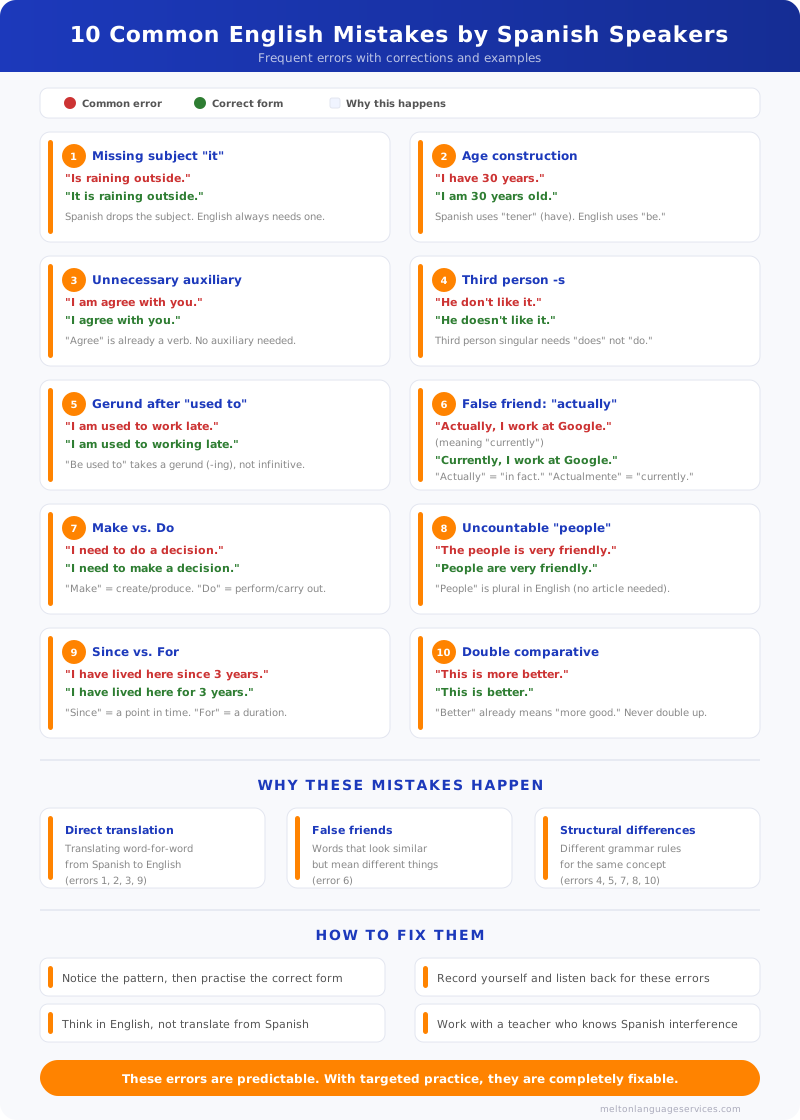
Spanish and English share a lot of vocabulary thanks to their Latin roots, but the grammar works very differently in many areas. Even advanced Spanish speakers make predictable mistakes in English, often because they are translating structures directly from Spanish. The good news is that once you know what to watch for, these errors are straightforward to fix.
1. Forgetting the subject pronoun
In Spanish, the verb conjugation tells you who is doing the action, so the subject pronoun is often dropped. “Tengo hambre” works perfectly without “yo.” In English, the subject is always required.
-
Incorrect: “Is raining outside.”
-
Correct: “It is raining outside.”
-
Incorrect: “Am tired.”
-
Correct: “I am tired.”
This also applies to “it” as a dummy subject: “It is important to plan ahead,” not “Is important to plan ahead.”
2. Confusing “make” and “do”
Spanish uses “hacer” for both, but English draws a clear distinction. “Make” is generally about creating or producing something. “Do” is about performing an action or task.
Use “make”:
- make a decision, make a mistake, make a suggestion, make progress, make an effort
Use “do”:
-
do business, do research, do a report, do your best, do the work
-
Incorrect: “We need to make more research before the meeting.”
-
Correct: “We need to do more research before the meeting.”
-
Incorrect: “She did a mistake in the calculations.”
-
Correct: “She made a mistake in the calculations.”
There is no single rule that covers every case. These are collocations, meaning fixed word combinations that native speakers learn through exposure. The most effective approach is to learn them in pairs rather than trying to apply a formula.
3. Misusing the present perfect
Spanish speakers often use the present perfect (he hecho, he ido) where English would use the simple past. In European Spanish, “esta mañana he ido al banco” is natural. In English, if the time period is finished, you use the simple past.
-
Incorrect: “I have seen that film last night.”
-
Correct: “I saw that film last night.”
-
Incorrect: “She has called me yesterday.”
-
Correct: “She called me yesterday.”
The English present perfect is used when the time is unfinished or unspecified: “I have seen that film” (at some point, no specific time) or “I have already called her today” (today is not finished).
4. Adding articles where they do not belong
Spanish uses articles far more liberally than English. “Me gusta la música” includes “la,” but the English equivalent does not.
-
Incorrect: “The life is short.”
-
Correct: “Life is short.”
-
Incorrect: “The technology is changing everything.”
-
Correct: “Technology is changing everything.”
-
Incorrect: “I studied the engineering at university.”
-
Correct: “I studied engineering at university.”
In English, general or abstract nouns (life, music, technology, love, education) do not take “the” unless you are referring to a specific instance: “The music at the event was excellent.”
5. False friends
These are words that look the same in both languages but mean different things. They cause constant confusion.
| Spanish word | Looks like | Actually means in Spanish | English equivalent |
|---|---|---|---|
| actual | actual | current, present | current |
| realizar | realise | carry out, complete | carry out |
| asistir | assist | attend | attend |
| sensible | sensible | sensitive | sensitive |
| éxito | exit | success | success |
| constipado | constipated | having a cold | having a cold |
| embarazada | embarrassed | pregnant | pregnant |
-
Incorrect: “The actual situation is complicated.” (meaning present)
-
Correct: “The current situation is complicated.”
-
Incorrect: “I need to assist to the conference.” (meaning attend)
-
Correct: “I need to attend the conference.”
6. Adjective placement
In Spanish, adjectives usually come after the noun: “un coche rojo.” In English, they almost always come before: “a red car.”
-
Incorrect: “We need to find a solution creative.”
-
Correct: “We need to find a creative solution.”
-
Incorrect: “She gave a presentation excellent.”
-
Correct: “She gave an excellent presentation.”
7. Mixing up “for” and “since”
Both translate to “desde” or “durante” in Spanish, which creates confusion. “For” refers to a duration of time. “Since” refers to a specific point in time when something started.
-
Incorrect: “I have worked here since five years.”
-
Correct: “I have worked here for five years.”
-
Incorrect: “She has been in Madrid for 2019.”
-
Correct: “She has been in Madrid since 2019.”
A simple test: if you can put a number and a time unit after it (three years, two months, ten minutes), use “for.” If it is a specific date, year, or event (Monday, 2019, I graduated), use “since.”
8. Double negatives
Spanish uses double negatives as standard grammar: “No tengo nada” is perfectly correct. In standard English, a double negative creates a positive meaning or sounds non-standard.
-
Incorrect: “I don’t have nothing to add.”
-
Correct: “I don’t have anything to add.” Or: “I have nothing to add.”
-
Incorrect: “She didn’t tell nobody.”
-
Correct: “She didn’t tell anybody.” Or: “She told nobody.”
9. Forgetting the third person “s”
Spanish verbs have distinct endings for every person. English verbs barely change, except for the third person singular in the present simple, which adds an “s.” Because the rest of the conjugation stays the same, Spanish speakers often forget this one.
-
Incorrect: “She work in marketing.”
-
Correct: “She works in marketing.”
-
Incorrect: “He always arrive late.”
-
Correct: “He always arrives late.”
This is one of the most basic mistakes, but it persists even at advanced levels because it is so easy to overlook.
10. Translating “people” as singular
“La gente” in Spanish is singular and takes a singular verb: “La gente quiere…” In English, “people” is plural.
-
Incorrect: “People is waiting in the lobby.”
-
Correct: “People are waiting in the lobby.”
-
Incorrect: “Most people thinks this is a good idea.”
-
Correct: “Most people think this is a good idea.”
How to fix these patterns
Knowing the rules is only the first step. Mistakes like these are deeply ingrained habits, and fixing them takes conscious practice. Some approaches that help:
- Focus on one mistake at a time. Trying to fix everything at once is overwhelming. Pick the one that affects your communication the most and work on it for a week.
- Read and listen in English regularly. Exposure to correct patterns trains your ear. Over time, incorrect sentences start to “sound wrong” before you even think about the rule.
- Get specific feedback. General correction (“your grammar needs work”) is not useful. You need someone who can identify your personal error patterns and help you address them systematically.
- Practise in context. Grammar drills have limited value if you cannot transfer the knowledge to real conversations. Practise the correct forms in situations that mirror your actual work.
Get targeted support for your English
At Melton Language Services, we work with Spanish-speaking professionals every day. Our trainers understand exactly where Spanish interferes with English, and our programmes are designed to target these patterns directly. Instead of working through a generic coursebook, we focus on the specific language challenges you face in your role.
Find out more about our business English programmes for companies or our individual English training for one-to-one coaching.