FUNDAE Explained: How Spain's Employer Training Credit Works
If you manage L&D or HR for a Spanish entity from outside Spain, FUNDAE is one of the largest training budgets you probably already have available and may not be using. The Spanish employer training credit system recovers a significant portion of the cost of staff training, including language training, by applying it against the monthly Social Security settlement. This guide explains how it works in 2026, what changed with the regulatory update earlier this year, and what to expect from a Spanish training provider that handles FUNDAE properly.
What FUNDAE is
FUNDAE (Fundación Estatal para la Formación en el Empleo) is the Spanish public body that administers the country’s employer-funded training credit system. Every Spanish-registered company that pays Social Security contributions also pays a small training levy as part of those contributions. FUNDAE lets the company recover part of that levy by applying it to training delivered to its employees.
Three things to clarify up front because they cause confusion for non-Spanish HR teams:
- It is not a grant. No money is received from FUNDAE. The company applies the credit against its monthly Social Security settlement.
- It is not a tax credit in the conventional sense. It applies to Social Security contributions, not corporate income tax.
- Language training is fully eligible. Both general language courses and specialised language training (ESP, English for Specific Purposes) qualify.
Who can use FUNDAE
Any Spanish-registered private company with employees in the general Social Security regime is eligible. The minimum is a single employee on payroll. Spanish branches of international groups qualify on the same basis as fully domestic Spanish companies.
Excluded: self-employed individuals with no staff, public administrations (which have their own training system), and certain social-economy entities.
The company must be current on Social Security and tax payments. If there are outstanding debts, the credit cannot be applied even if training was delivered correctly.
How the annual credit is calculated
Two variables: the training levy the company paid the previous year and the percentage that applies based on company size.
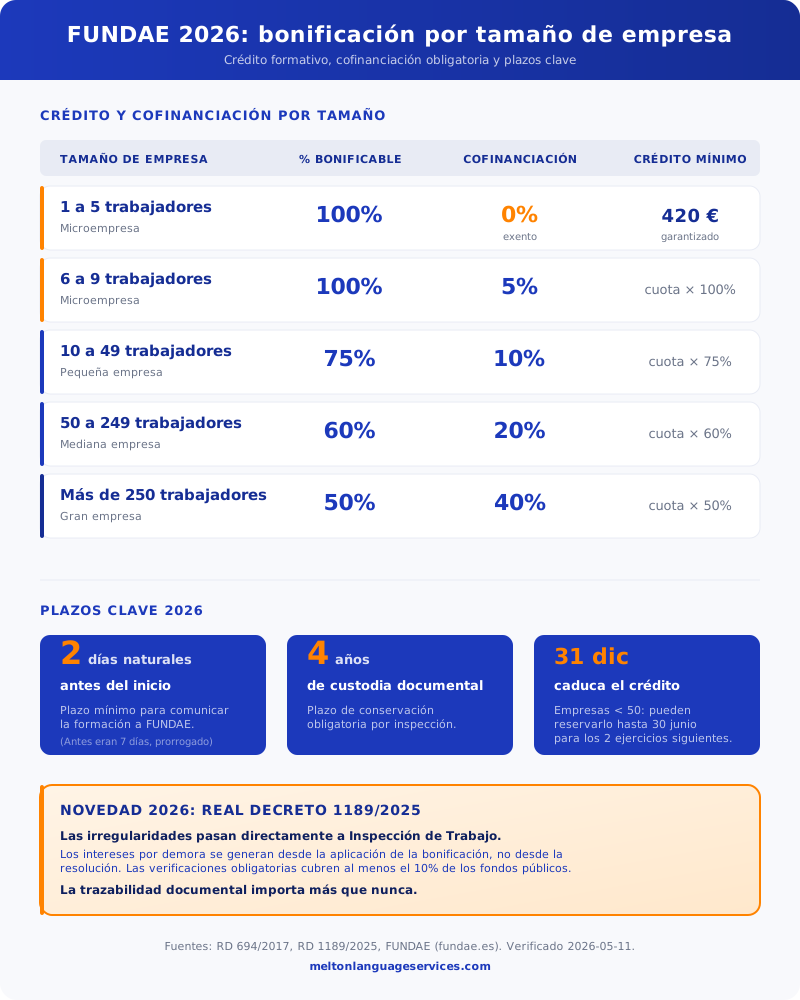
| Company size | Recoverable percentage | Minimum guaranteed credit |
|---|---|---|
| 1 to 5 employees | 100% | 420 € |
| 6 to 9 employees | 100% | levy × 100% |
| 10 to 49 employees | 75% | levy × 75% |
| 50 to 249 employees | 60% | levy × 60% |
| 250 or more employees | 50% | levy × 50% |
Companies with 1 to 5 employees have a minimum guaranteed credit of 420 € per year even if their actual levy was lower. This floor is set by article 9.4 of Royal Decree 694/2017.
The current credit is visible inside the FUNDAE application using the company’s digital certificate. You do not need to calculate it manually if you have access.
Co-funding: what the company has to contribute
The credit does not cover the full cost of training in every case. The company contributes a percentage based on size:
- 1 to 5 employees: exempt, no co-funding required.
- 6 to 9 employees: 5%.
- 10 to 49 employees: 10%.
- 50 to 249 employees: 20%.
- 250 or more employees: 40%.
Co-funding does not necessarily mean paying additional cash. FUNDAE accepts as co-funding the labour cost of employees attending training during paid working hours, organisational costs, and certain other elements. The provider should explain exactly what counts in your case.
Eligible language training formats
FUNDAE accepts three modalities, all applicable to language training:
- In-person classes with attendance signed by participants each session. Live online classes (delivered via videoconference with a teacher in real time) count as in-person delivery.
- Tracked online training with a qualified teacher and a FUNDAE-certified learning platform. The platform must log every connection, content access, and learner activity.
- Blended programmes combining in-person and online. The in-person portion must represent at least 20% of total hours.
Pure self-paced learning (e.g. buying language-app licences for employees without an accompanying tutored programme) is not eligible. Apps can be a component of a broader programme, but cannot be the whole thing.
Eligible content includes general English by CEFR level, English for Specific Purposes (ESP) tailored to the sector, official exam preparation (Cambridge, IELTS, TOEFL) when it sits inside a documented training plan, and training in other languages (Spanish for foreigners, French, Arabic, German) with the same requirements.
The bonification process in six steps
A qualified Spanish provider handles most of this on your behalf. What you need to know is what each step looks like and what documents you should ask the provider to deliver.
- Needs analysis. The provider identifies what the team needs in the target language, the workplace situations where communication breaks down, and the business outcomes you expect.
- Training plan. The provider drafts a written plan with objectives, content, duration, delivery format, and evaluation method.
- FUNDAE notification. The provider (or your payroll team) submits the notification through the FUNDAE application at least 2 calendar days before the group starts. This deadline was reduced from the original 7 days as an emergency measure in 2020 and has been extended every year since, most recently by the Resolución of 21 November 2024.
- Delivery. Classes run with attendance control (in-person) or connection logging (online), tracked content, formal evaluation, and a certificate at the end.
- Credit applied. The company applies the credit on the RLC (Recibo de Liquidación de Cotizaciones), Spain’s monthly Social Security settlement, the month following the end of the training. The old TC1 and TC2 forms were replaced when SILTRA went live in 2014, though many outdated guides still mention them.
- Document retention. The company keeps all the documentation for 4 years in case of inspection.
Key 2026 deadlines
- FUNDAE notification: minimum 2 calendar days before each group starts. In force in 2026 by extension.
- Group modifications: up to 24 hours before start.
- Credit application window: from the RLC of the month following training end through the December RLC (filed in January the following year).
- Document retention: 4 years from training end.
- Annual credit expiry: 31 December.
- Carry-over reservation for companies with fewer than 50 employees: unused credit can be reserved and applied across the next two fiscal years, if communicated through the FUNDAE application before 30 June of the same year.
What changed in 2026: Royal Decree 1189/2025
The Spanish regulation governing FUNDAE was updated by RD 1189/2025, in force from 2026. The practical changes for HR teams:
- Irregularities flagged by SEPE (the public employment service) now pass directly to the Labour Inspectorate. The previous appeals step at SEPE is gone, so issues escalate to a formal procedure faster.
- Late-payment interest now accrues from the date the credit was applied, not from the inspection resolution.
- Mandatory verification audits must cover at least 10% of public funds applied each year. Expect more inspections.
- Seasonal employees on fixed-discontinuous contracts can bonificate training even during their non-working periods. Useful for sectors with strong seasonality.
- Mandatory training (such as occupational health and safety) was officially confirmed as eligible, ending a long-running debate.
The takeaway: documentation quality and traceability matter more than ever in 2026. A provider that cuts corners on the paperwork is now a real liability, not just a minor inconvenience.
What to ask a Spanish language training provider
If your Spanish entity is evaluating providers, these are the questions that separate serious operators from the rest:
- How will you calculate our specific annual credit and the co-funding that applies to our company size?
- Will you submit the FUNDAE notification on our behalf, or do we need to do it through payroll?
- What documentation do you deliver after each training action, and in what format?
- How do you handle attendance tracking for in-person and online sessions?
- Can you show us an example of the complete documentation pack for a programme you delivered in the last 12 months?
- How do you adapt the training to our sector? (If they answer with a coursebook title, that is the wrong answer.)
A provider that handles FUNDAE properly will answer these without hesitation. A provider that does not will give you general reassurances and change the subject.
How Melton Language Services handles FUNDAE
We have been designing language training programmes for Spanish and European companies for over 25 years. FUNDAE handling is standard in every programme we deliver.
We support clients on credit calculation, training plan design, FUNDAE notifications, attendance tracking, and document retention. Our programmes use the ESP (English for Specific Purposes) methodology, which means the materials are built around your sector and your team’s actual work, not a generic coursebook. We work with companies across defence and public institutions, cybersecurity, energy, finance, EU institutions, and other specialised sectors.
If your Spanish entity is planning language training for 2026 and wants to apply FUNDAE properly, we can help you make full use of the credit available.
Frequently asked questions
What is FUNDAE in simple terms?
FUNDAE (Fundación Estatal para la Formación en el Empleo) is the Spanish public body that runs the employer training credit system. Spanish-registered companies can recover part of the Social Security training contribution they pay each year by applying it to staff training, including language training. It is not a grant or subsidy. It is a credit applied against the monthly Social Security settlement.
Can my Spanish entity bonificate 100% of the cost of English classes?
Only companies with 1 to 5 employees are exempt from co-funding and can recover 100% of the eligible cost. Companies with 6 to 9 employees contribute 5%, 10 to 49 contribute 10%, 50 to 249 contribute 20%, and 250 or more contribute 40%. The company contribution can include the salary cost of employees attending training during working hours.
What is the deadline to notify FUNDAE before training starts in 2026?
In 2026 the deadline is 2 calendar days before the group starts. The original 2017 regulation specified 7 days, reduced to 2 days as an emergency measure in 2020 and renewed every year since. The most recent renewal is the Resolución of 21 November 2024. If the notification is not made on time, the training cannot be bonificated.
What types of language training are eligible for FUNDAE?
Eligible: in-person classes with attendance control, online classes with a qualified teacher and a tracked learning platform, blended programmes (at least 20% in-person), and exam preparation as part of a documented plan. Not eligible: fully self-paced apps without a teacher, untracked content, or single-session classes without a structured plan.
How long does the company have to keep training documentation?
Four years. The company must keep the provider contract, training plan, FUNDAE notification, attendance or platform connection logs, content delivered, evaluation, and certificate. Under RD 1189/2025, in force from 2026, FUNDAE inspections must cover at least 10% of public funds applied each year, so the audit risk is higher than in previous years.
Does unused credit roll over to the next year?
For companies with 50 or more employees, no. Unused credit expires on 31 December. For companies with fewer than 50 employees, the unused credit can be reserved and applied across the following two fiscal years, but only if the company communicates this decision before 30 June of the same year through the FUNDAE application. Without that notification, the credit is lost.
Sources
- Royal Decree 694/2017 of 3 July. Spanish Official Gazette (BOE).
- Royal Decree 1189/2025 (in force from 2026).
- FUNDAE: Bonificación de acciones programadas. www.fundae.es.
- Resolución of 21 November 2024 (extending the 2-day notification deadline).
Last regulatory verification: 11 May 2026. This page is reviewed every 6 months (January and July) to reflect regulatory updates.