How to Learn English as a Busy Adult: 20 Tips That Work
Updated: 21 September 2026
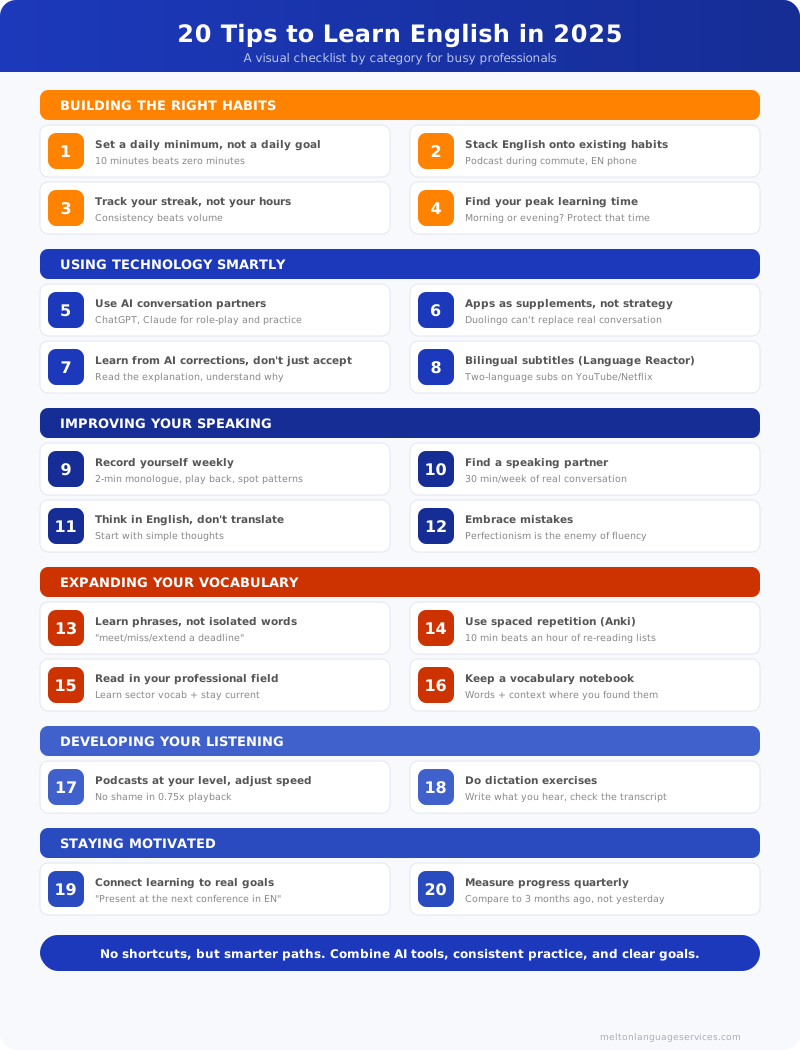
Learning English as an adult professional is a different game from learning it at school. You have less time, higher stakes, and specific goals. Here are twenty tips that reflect how people actually learn languages in 2026, not how textbooks say they should.
Building the right habits
1. Set a daily minimum, not a daily goal. Instead of “study for an hour,” commit to “do something in English for ten minutes.” On busy days, you still make progress. On free days, you naturally do more.
2. Stack English onto existing habits. Listen to an English podcast during your commute. Switch your phone language to English. Read industry news in English over your morning coffee. The less effort it takes to start, the more likely you are to keep going.
3. Track your streak, not your hours. Consistency matters more than volume. A 30-day streak of fifteen minutes beats three hours once a week. If you want a structured framework, our 30-day English challenge breaks the habit into weekly themes.
4. Find your peak time. Some people absorb language better in the morning. Others are sharper in the evening. Pay attention to when you learn best and protect that time.
Using technology smartly
5. Have real conversations with AI. Tools like ChatGPT, Gemini, and Claude now offer voice modes where you can hold a spoken conversation. Ask them to role-play a job interview, a client presentation, or a difficult phone call. They will correct your grammar in real time, explain idioms, and adjust their pace to your level. This is genuinely transformative for professionals who do not have a conversation partner available. For a deeper look at how professionals are using these tools at work, see our guide to AI tools for language learning at work.
6. Use AI to create personalised study material. Ask an AI assistant to generate a vocabulary list for your sector, write a mock email for you to respond to, or create a quiz based on an article you just read. The ability to get material tailored to your exact needs and level is something that was not possible even two years ago.
7. Try language learning apps, but do not rely on them. Duolingo, Babbel, and similar apps are great for vocabulary and basic structures. But they cannot replace real conversation. Use them as supplements, not as your main strategy.
8. Use AI writing assistants to learn, not just to write. When Grammarly or a similar tool corrects your writing, do not just accept the change. Read the explanation. Understand why it was wrong. That is where the learning happens.
9. Watch content with bilingual subtitles. Platforms like Language Reactor let you display subtitles in two languages simultaneously on YouTube and Netflix. This is one of the most effective passive learning techniques available.
Improving your speaking
10. Record yourself. Use your phone to record a two-minute monologue about your day, a work topic, or a news story. Play it back. You will notice patterns you want to fix. Do this weekly and you will hear your own progress.
11. Find a speaking partner. Whether it is a colleague, a language exchange partner, or a teacher, regular conversation practice is irreplaceable. Aim for at least one 30-minute session per week.
12. Do not translate in your head. This is hard to break, but try to think in English rather than translating from your native language. Start with simple thoughts: “I need coffee” rather than mentally constructing the sentence in Spanish first.
13. Embrace mistakes. Every mistake is data. The people who improve fastest are the ones willing to sound imperfect while they practise. Perfectionism is the enemy of fluency.
Expanding your vocabulary
14. Learn phrases, not words. Instead of memorising “deadline,” learn “meet a deadline,” “miss a deadline,” “extend a deadline.” Phrases are more useful than isolated words because they teach you how words actually behave together.
15. Use spaced repetition. Apps like Anki use algorithms to show you vocabulary at the optimal interval for retention. Add new words you encounter in real life and review them daily. Ten minutes of spaced repetition beats an hour of re-reading lists.
16. Read in your professional field. Industry articles, reports, and newsletters in English expose you to the vocabulary you actually need. Bonus: you stay current in your field at the same time.
17. Keep a vocabulary notebook. Digital or physical, it does not matter. Write down new words and phrases with the context where you found them. Context is what makes vocabulary stick.
Developing your listening
18. Listen to podcasts in your own sector. Start with podcasts designed for English learners, then graduate to native content in your field. Listening to topics you already understand makes it easier to pick up new vocabulary because your brain can focus on the language, not the concepts.
19. Do dictation exercises. Listen to a short clip and try to write down exactly what you hear. This forces deep listening and reveals gaps between what you think you heard and what was actually said.
Staying motivated
20. Measure progress quarterly, not daily. Language learning is slow and non-linear. You will have weeks where you feel stuck. Compare where you are now to where you were three months ago, and the progress becomes obvious. Keep a short journal of things you can do now that you could not do before: followed a meeting without subtitles, wrote an email without Google Translate, understood a joke in English.
The learning plateau and how to break through it
Most adult learners hit a wall somewhere in the B2 range. The first big jumps from beginner to intermediate feel obvious. You start understanding more, you start speaking more, you start reading more. Then progress slows to a crawl and everything feels the same for months.
This is the classic intermediate plateau, and it happens because the earlier gains came from adding new grammar and vocabulary. At B2 you already have enough to function in most business situations. Further progress means refining what you already have, not stacking more on top.
Three tactics tend to work for breaking through.
Change the level of your input. If you have been reading the same news sites for two years, they are still teaching you the same words. Switch to material that stretches you. Long-form journalism, sector white papers, a novel by a modern British or American author, a podcast that assumes native comprehension. Discomfort is the point. If you understand every word, the material is no longer teaching you.
Add pressure to your output. Speaking to yourself in the shower will not push you past B2. Presenting to a real audience, running a meeting in English, or writing a report your boss will read forces a precision that self-directed practice does not. If your job does not create this pressure, invent it. Volunteer for the English-language project. Offer to run the next client call. Sign up to present at a conference.
Get corrected by someone who understands your goals. At lower levels almost any correction helps. At B2 and above you need feedback from someone who can tell you why a phrase sounds off, not just that it does. Working with a professional teacher, especially one who understands your sector, pays back the most at this stage. Corrections have to land on the specific gaps that separate you from a C1 speaker in your field.
Building English input around your job, not around your English
The biggest shift in how professionals learn English in recent years is the move away from generic study material toward job-embedded input. It works because the vocabulary you actually need is the vocabulary you meet in your work, and meeting it repeatedly in real contexts is how it sticks.
A few practical ways to build this in.
Read the trade press in English. Whatever sector you work in has English-language publications. Legal teams have Law360 and The Lawyer. Cybersecurity teams have Dark Reading and The Hacker News. Pharma teams have Fierce Pharma and BioSpace. Add two or three of these to your morning reading routine. You will absorb sector vocabulary faster than any coursebook could teach you.
Follow industry voices on LinkedIn in English. Set your LinkedIn interface to English and follow ten to fifteen people who post about your field in English. Comment on posts occasionally. Writing a two-sentence comment in English on a topic you know well is one of the most efficient forms of practice available. Real audience, low stakes, immediate feedback in your notifications.
Listen to sector podcasts on your commute. Every industry has an English-language podcast now. Search “your sector + podcast” and pick two that publish weekly. Start with episodes where you already know the topic well. Familiar content lets your brain focus on the language, not the concepts. Once that feels comfortable, move to episodes on subjects that are new to you.
Take internal notes in English. Meeting notes, to-do lists, project plans, personal reminders. Doing this in English costs no extra time and produces daily writing practice that connects directly to your work.
Using AI feedback loops without becoming dependent
AI tools have changed how adults can learn English. Used well, they give you an unlimited supply of tailored practice and instant correction. Used badly, they replace your own thinking and leave you no better off than before you started.
The difference between the two is whether you are producing English or having it produced for you.
Write first, then get feedback. Draft the email, the report, or the message yourself. Then paste it into an AI tool and ask for corrections plus explanations. Read the explanations. Do not just accept the changes. This turns the AI into a private tutor rather than a ghostwriter.
Ask for options, not answers. Instead of asking for “the correct version,” ask for three phrasings with a note on when each one fits. This teaches register and nuance, which is where B2 to C1 progress lives. You learn to choose between “I would appreciate,” “It would be helpful if you could,” and “Please” based on the relationship and the situation.
Use voice mode for spaced conversation practice. Ten minutes a day of spoken conversation with an AI tool, on topics from your work, will build fluency faster than reading grammar rules. Ask it to interrupt and correct you when you make mistakes, then ask it to explain the correction before you continue.
Set your own limits. Decide in advance which tasks you will do without AI help. Reading, listening, and speaking without a safety net are the tasks that build the skills you need when the tool is not there. A real meeting or interview is not the moment to discover you cannot form a sentence without ChatGPT open in a tab.
The professionals who improve fastest treat AI as a training partner. They use it to compress feedback loops that used to take weeks. They still do the work.
The bottom line
There is no shortcut to learning English, but there are smarter paths. The tools available in 2026 are genuinely powerful, from AI voice conversations to personalised study material to bilingual subtitle extensions. But tools alone are not enough. Combine them with consistent practice, real conversations, and clear goals, and progress is inevitable.
FAQ
What is the fastest way to learn English as a busy adult?
The fastest way is consistent short sessions tied to your real work, not long study blocks. Twenty minutes a day of focused practice with material you actually need, such as emails, meeting notes, or sector reading, will outperform two-hour weekend sessions. Pair that with one weekly conversation, either with a teacher or a language exchange partner, and you have the minimum stack that produces measurable progress in three months.
Can adults reach a high level of English without living abroad?
Yes. The ceiling on adult learners has been raised significantly by AI tools, native-content platforms, and remote conversation practice. Plenty of professionals reach C1 without ever moving abroad. What matters more than location is regular exposure to English at the level just above your current ability, plus active speaking practice. Living abroad helps, but it is not the gating factor it was twenty years ago.
How long does it take to improve English from B2 to C1?
Roughly 200 to 400 hours of focused study and practice, depending on intensity and method. At an hour a day with structured input, output, and feedback, that is six to twelve months. The jump from B2 to C1 is the slowest stage for most learners because the gains become qualitative rather than quantitative. You stop adding obvious skills and start refining nuance, register, and idiomatic range.