30-Day English Challenge: Build a Habit That Sticks
Updated: 13 April 2026
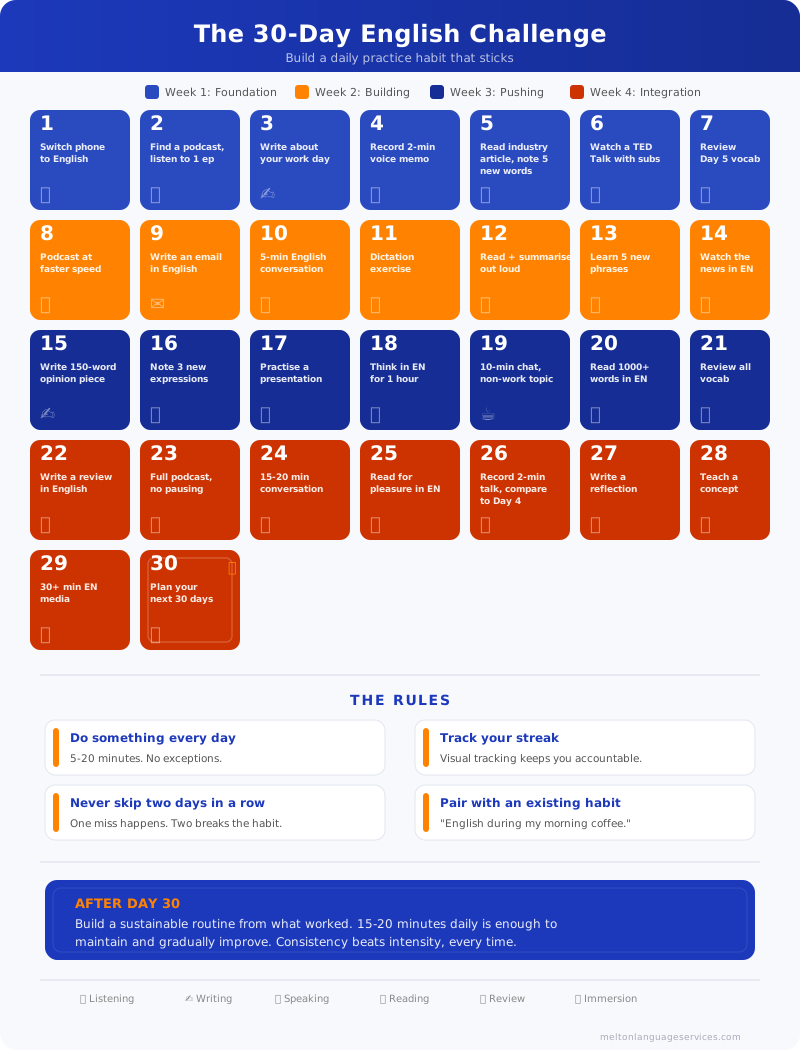
You have signed up for courses, downloaded apps, bought textbooks, and started learning plans that fizzled out within two weeks. The problem was never your ability. It was consistency. Language learning fails when practice feels like an event rather than a routine.
This 30-day challenge is designed to fix that. The daily commitments are small, ranging from five to twenty minutes. The goal is not to transform your English in a month. It is to build a practice habit that becomes automatic, something that lasts well beyond Day 30.
The rules
- Do something in English every day. No exceptions, no excuses.
- Keep it short. Each activity takes five to twenty minutes. You can always do more, but the minimum is what matters.
- Track your streak. Use a calendar, an app, or a piece of paper on your desk. Visual tracking keeps you accountable.
- Do not skip two days in a row. Missing one day happens. Missing two breaks the habit. If you miss a day, make the next one non-negotiable.
Week 1: Foundation
The first week is about establishing the routine. Keep it easy.
Day 1: Switch your phone language to English. Leave it that way for the entire 30 days.
Day 2: Find an English podcast that interests you. Listen to one episode during your commute or while exercising.
Day 3: Write a short paragraph in English about what you did at work today. Do not use a translator.
Day 4: Record a two-minute voice memo in English about any topic. Listen back and note one thing you want to improve.
Day 5: Read one article in English related to your industry. Write down five new words or phrases.
Day 6: Watch a short video in English with subtitles. A TED Talk under ten minutes works well.
Day 7: Review the five words from Day 5. Can you use each one in a sentence?
Week 2: Building skills
Now that the routine is established, increase the challenge slightly.
Day 8: Listen to a podcast at slightly faster than comfortable speed. Rewind and re-listen to sections you missed.
Day 9: Write an email in English. It can be real or imagined. Focus on getting the tone right.
Day 10: Have a five-minute conversation in English. With a colleague, a language partner, or an AI chatbot (tools like ChatGPT or Claude can role-play realistic conversations on any topic).
Day 11: Do a dictation exercise. Listen to a 30-second clip and write down exactly what you hear. Check against the transcript.
Day 12: Read an English article and summarise it out loud in your own words. Record yourself.
Day 13: Learn five new phrases (not individual words). Use a flashcard app to review them.
Day 14: Watch the news in English. Try BBC World Service or CNN International. Take notes on the main stories.
Week 3: Pushing boundaries
By now, daily English practice should feel normal. Time to stretch.
Day 15: Write a short opinion piece (150-200 words) on a topic you care about. Focus on expressing your ideas clearly.
Day 16: Listen to a conversation between native speakers (a podcast interview works well). Note three expressions or phrases you had not heard before.
Day 17: Practise a work presentation in English. Even if the real one will be in your language, doing it in English builds versatility.
Day 18: Try thinking in English for one hour. Narrate your activities silently in your head.
Day 19: Have a ten-minute conversation in English about something other than work. Hobbies, travel, food, anything personal.
Day 20: Read a longer text in English, at least a thousand words. A blog post, a report, or a magazine article. Notice how the writer structures their argument.
Day 21: Review all the vocabulary you have collected over the past three weeks. How many words and phrases can you actively use?
Week 4: Integration
The final week is about making English part of your daily life, not something separate from it.
Day 22: Write a review of a product, restaurant, or film in English. Post it somewhere if you are comfortable.
Day 23: Listen to a full podcast episode without pausing. At the end, summarise the key points out loud.
Day 24: Have the longest conversation in English you have had this month. Aim for fifteen to twenty minutes.
Day 25: Read something for pleasure in English. A short story, a chapter of a book, or a long-form article on a topic you enjoy.
Day 26: Record yourself giving a two-minute talk about your area of expertise. Compare it to your Day 4 recording. Notice the improvement.
Day 27: Write a reflective entry about what you have learned this month. What felt easy? What was hard? What will you continue?
Day 28: Teach someone a concept in English. Explaining things clearly is one of the highest-level language skills.
Day 29: Consume English media for at least 30 minutes. A film, a series, a documentary, or a long podcast.
Day 30: Plan your next 30 days. Which activities worked best? Build a routine from those.
Making the most of AI tools
AI language tools have become remarkably useful for independent practice. Here are some ways to work them into your challenge:
- Conversation practice: Ask an AI chatbot to role-play a scenario (a job interview, a client call, a salary negotiation). It will adapt to your level and give you unlimited practice without judgment.
- Writing feedback: Write your Day 3, Day 9, or Day 15 texts and paste them into an AI tool. Ask it to identify errors and suggest more natural phrasing.
- Vocabulary building: After reading an article, ask an AI to quiz you on the new vocabulary in context. This is more effective than flashcards for building active recall.
- Pronunciation check: Some AI tools now offer voice interaction. Use these to practise speaking and get feedback on clarity.
AI tools are not a replacement for real human conversation, but they are excellent for the kind of daily, low-pressure practice that builds confidence over time.
After the challenge
The point of the challenge is not the 30 days. It is what comes after.
By Day 30, you should have a clear sense of which activities you enjoy, which ones challenge you, and how much time you can realistically commit each day. Build a sustainable routine from those insights.
Most people find that 15 to 20 minutes of daily practice is enough to maintain and gradually improve their level. The key is consistency. A short daily practice is worth more than an occasional long session.
Tips for success
- Tell someone about the challenge. Accountability helps.
- Pair it with an existing habit. “I listen to English during my morning coffee” is more likely to stick than “I study English every day.”
- Do not aim for perfection. Some days you will do the bare minimum. That counts.
- Celebrate your streak. Reaching Day 7, Day 14, Day 21, and Day 30 are all worth acknowledging.
Key takeaways
- Consistency matters more than intensity
- Small daily commitments build lasting habits
- Track your progress visually
- After 30 days, build a sustainable routine from what worked
- The goal is a permanent practice habit, not a one-month sprint
The professionals who maintain their English level are the ones who practise a little bit every day. This challenge gives you the structure to start. What you do after Day 30 is what really counts.