English Exam Speaking Tips: How to Score Higher
Updated: 13 April 2026
You have spent months preparing your grammar, building your vocabulary, and practising reading and listening. Then you walk into the speaking test and your mind goes blank. The speaking part of an English exam is the section that generates the most anxiety for candidates at every level. It is live, it is timed, and there is no going back to revise an answer.
The good news? It is also the section where targeted preparation makes the biggest difference. Here is what actually helps, based on years of preparing professionals for Cambridge, IELTS, and other major English exams.
Understand what examiners are looking for
Examiners are not looking for perfection. They are assessing specific criteria, and understanding these criteria gives you a huge advantage.
Cambridge exams (B2 First, C1 Advanced, C2 Proficiency)
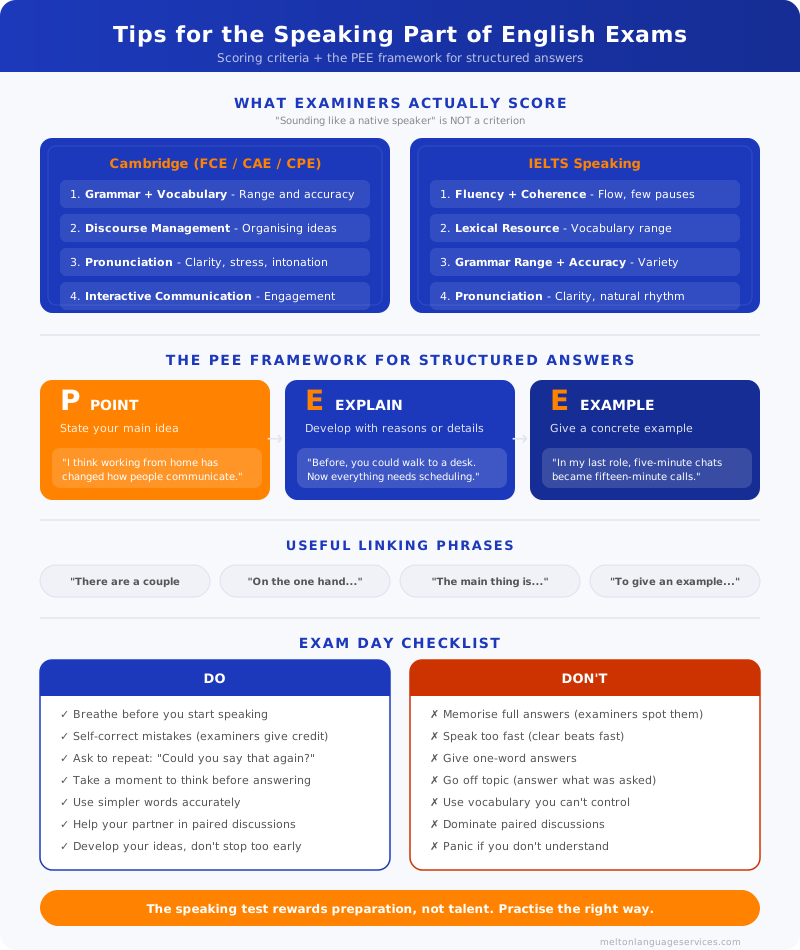
Examiners score you on four things:
- Grammar and vocabulary: Range and accuracy
- Discourse management: How well you organise and develop your ideas
- Pronunciation: Clarity, stress, and intonation (not having a “native” accent)
- Interactive communication: How well you engage with your partner and the examiner
IELTS Speaking
Scored on:
- Fluency and coherence: Can you speak without too many pauses and hesitations?
- Lexical resource: Range of vocabulary
- Grammatical range and accuracy: Variety and correctness of structures
- Pronunciation: Clarity and natural rhythm
In both cases, notice that “sounding like a native speaker” is not a criterion. Clarity and range are what matter.
Managing nerves
Before the exam
- Prepare, but do not over-prepare. Memorised answers sound robotic and examiners recognise them instantly.
- Practise under realistic conditions. Set a timer. Record yourself. Practise with a partner if possible.
- Sleep well the night before. This advice sounds boring because it is obvious. It is also the most impactful thing you can do for your performance.
During the exam
- Breathe. Before you start speaking, take a breath. A one-second pause feels like an eternity to you but is completely natural to the listener.
- It is fine to self-correct. If you make a mistake, correct it and move on. Examiners give credit for self-correction.
- Do not panic if you do not understand a question. Ask the examiner to repeat it. “Could you say that again, please?” is a perfectly acceptable response.
Structuring your answers
Avoid one-word answers
If the examiner asks “Do you enjoy travelling?”, do not say “Yes.” Say “Yes, I really enjoy it, particularly travelling within Europe. I try to visit somewhere new at least once or twice a year.”
Use the PEE framework
For longer answers, structure your response:
- Point: State your main idea
- Explain: Develop it with reasons or details
- Example: Give a concrete example
“I think working from home has changed the way people communicate. (Point) Before, you could just walk over to a colleague’s desk, but now everything needs to be scheduled. (Explain) For instance, in my last role, we went from having five-minute chats to booking fifteen-minute calls for the same conversations. (Example)“
Signal your structure
Use linking phrases to show the examiner you are organising your thoughts:
- “There are a couple of reasons for this…”
- “On the one hand… On the other hand…”
- “The main thing I would say is…”
- “To give you an example…”
Specific exam tips
Cambridge paired discussion
In Cambridge exams, you do part of the speaking test with another candidate. This is collaborative, not competitive.
- Listen to your partner and respond to what they say
- Ask follow-up questions: “That is interesting. Do you think…?”
- Do not dominate the conversation, but do not go silent either
- If your partner is struggling, help them. Examiners notice this and it counts positively
IELTS Part 2 (the long turn)
You get a topic card and one minute to prepare a two-minute talk. Use your preparation time well:
- Jot down three or four key points, not full sentences
- Think about specific examples you can use
- Plan a clear opening and closing
- Keep an eye on the time. Two minutes is longer than you think
IELTS Part 3 (the discussion)
This is where you can really show your level. The examiner asks abstract questions related to your Part 2 topic.
- Take a moment to think before answering. It shows maturity, not weakness.
- Speculate when appropriate: “I suppose…” / “It is hard to say for certain, but…”
- Use conditional structures: “If governments invested more in…, then we might see…”
Common mistakes to avoid
- Rehearsed speeches: Examiners spot them immediately. They will change the question to get a genuine response.
- Using vocabulary you cannot control: It is better to use simpler words accurately than complex words incorrectly.
- Speaking too fast: Pace yourself. Clear, measured speech scores higher than fast, unclear speech.
- Going off topic: Answer the question you were asked, not the question you prepared for.
- Stopping too early: If you finish a point quickly, add detail. Develop your ideas.
Online and computer-based speaking tests
More exam providers now offer digital or remote-format speaking tests. IELTS has introduced computer-delivered tests in many centres, and Linguaskill (Cambridge’s online assessment tool) includes a fully computer-based speaking section where you record your answers rather than speaking to an examiner.
If you are taking a computer-based speaking test:
- Practise speaking to a screen. It feels different from talking to a person. Record yourself answering practice questions on your laptop so the format feels familiar.
- Manage your timing carefully. Computer-based tests often have strict time limits with a countdown timer. Practise answering within set time windows.
- Speak clearly and at a consistent volume. The microphone picks up everything, including hesitations and trailing off. Project your voice as you would in a meeting.
- Do not wait for feedback. There is no examiner nodding or smiling. This can feel unsettling. Trust your preparation and keep talking.
Whether you test in person or online, the scoring criteria remain the same. The format changes, but what examiners are looking for does not.
The weeks before the exam
- Practise speaking for two to three minutes on random topics. Use a timer.
- Record yourself at least twice a week and listen back critically.
- Practise with a partner or teacher who can give honest feedback.
- Do full practice tests under timed conditions.
- Focus on areas where you lose marks, not on areas where you are already strong.
Key takeaways
- Understand the scoring criteria for your specific exam
- Structure your answers with point, explanation, and example
- Self-correction is a strength, not a weakness
- Practise under realistic conditions, including timing
- Clarity and range matter more than sounding “native”
The speaking test rewards preparation, not talent. The candidates who perform best are the ones who have practised in the right way, not the ones who have the best English.