Alternatives to Increase and Decrease: Words with Impact
Updated: 10 May 2026
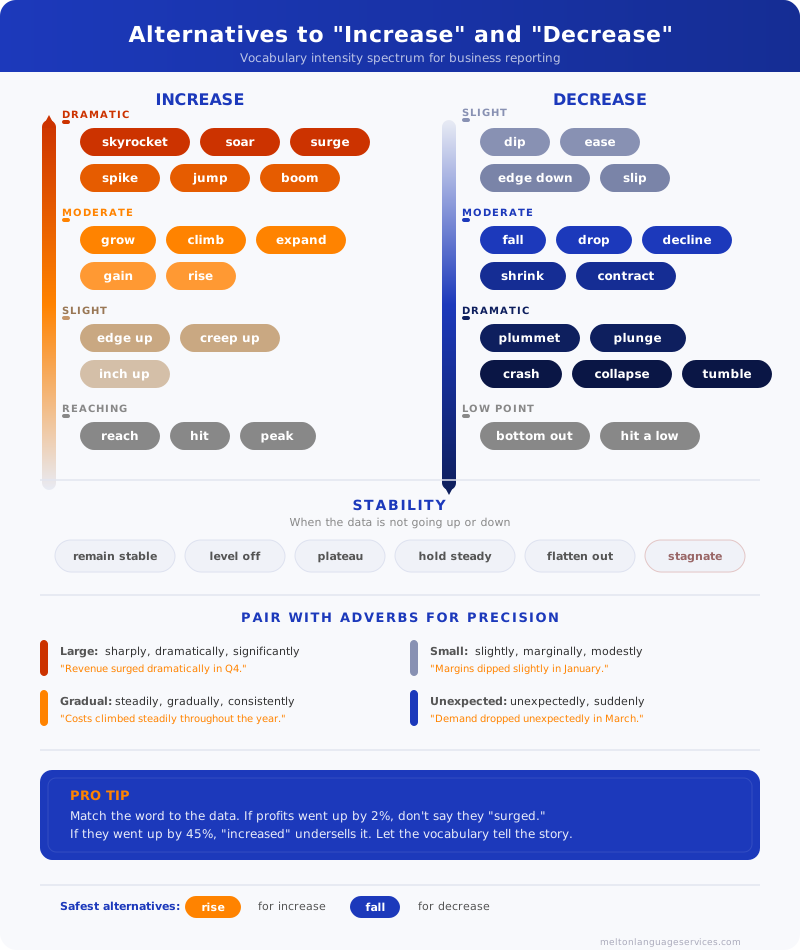
Open any quarterly report and you will find the same pattern: revenue increased, costs decreased, headcount increased, churn decreased. The words are correct, but after the third paragraph, they start to blur together. Your reader stops paying attention because the language offers no texture, no sense of whether that increase was a gradual crawl or a dramatic surge.
Professional English has dozens of alternatives for these two words, each with a different shade of meaning. Choosing the right one makes your writing more precise and more engaging. Here is a practical guide, organised by intensity and context.
Alternatives to “increase”
Slight or gradual increases
- Rise: “Profits rose by 3% in Q2.” (neutral, works everywhere)
- Edge up: “Margins edged up slightly.” (very small, gradual)
- Creep up: “Costs have been creeping up over the past six months.” (slow, possibly unnoticed)
- Inch up: “Share prices inched up this week.” (minimal movement)
Moderate increases
- Grow: “Revenue grew steadily throughout the year.” (positive connotation)
- Climb: “Customer numbers climbed to 50,000.” (steady upward movement)
- Expand: “The team expanded by 20%.” (commonly used for size, capacity, and scope)
- Gain: “The stock gained 4% on Tuesday.” (commonly used in finance)
Sharp or dramatic increases
- Surge: “Demand surged after the product launch.” (sudden, dramatic)
- Soar: “Exports soared to record levels.” (very large increase)
- Spike: “There was a spike in web traffic.” (sudden, possibly temporary)
- Jump: “Sales jumped 25% in December.” (sudden, significant)
- Skyrocket: “Energy prices skyrocketed.” (extreme, often negative context)
- Boom: “The market is booming.” (sustained, dramatic growth)
Reaching a level
- Reach: “Revenue reached 10 million euros.”
- Hit: “We hit our target ahead of schedule.” (informal but common in business)
- Peak: “Demand peaked in July.” (implies it came down afterwards)
Alternatives to “decrease”
Slight or gradual decreases
- Dip: “Sales dipped slightly in January.” (small, possibly temporary)
- Ease: “Inflation eased to 2.1%.” (positive connotation: the decrease is welcome)
- Edge down: “Interest rates edged down.” (minimal)
- Slip: “Market share slipped by half a percent.” (small, possibly concerning)
Moderate decreases
- Fall: “Exports fell by 8%.” (neutral, widely used)
- Drop: “Revenue dropped in the third quarter.” (fairly sharp)
- Decline: “Customer satisfaction declined steadily.” (gradual, formal)
- Shrink: “The market shrank by 12%.” (reduction in size)
- Contract: “The economy contracted for the second consecutive quarter.” (formal, economic context)
Sharp or dramatic decreases
- Plummet: “Share prices plummeted overnight.” (dramatic, negative)
- Plunge: “Profits plunged 40%.” (dramatic fall)
- Crash: “The market crashed.” (sudden, severe)
- Collapse: “Demand collapsed after the regulation change.” (total or near-total)
- Tumble: “The currency tumbled against the dollar.” (rapid, significant)
Reaching a low point
- Bottom out: “We believe sales have bottomed out.” (reached the lowest point, may recover)
- Hit a low: “Customer numbers hit a five-year low.”
Describing stability
Sometimes the data is not going up or down:
- Remain stable / steady: “Prices remained stable throughout Q4.”
- Level off / level out: “Growth levelled off after two years of expansion.”
- Plateau: “Revenue has plateaued at around 5 million.”
- Hold steady: “Employment held steady despite the downturn.”
- Flatten out: “The curve flattened out in the second half of the year.”
- Stagnate: “Wages have stagnated.” (negative connotation: stability is not welcome)
Adverbs that add precision
Pair your verb with an adverb to be more specific:
- Sharply / dramatically / significantly: large change
- Steadily / gradually / consistently: slow, continuous change
- Slightly / marginally / modestly: small change
- Unexpectedly / suddenly: change that was not predicted
- Briefly / temporarily: change that did not last
Example: “Revenue grew steadily throughout 2024 before dipping slightly in January.”
Combining verbs with time references
The right verb becomes even more effective when paired with a clear time frame. Here are some patterns that work well in reports and presentations:
- “Revenue surged in Q3 before levelling off towards the end of the year.”
- “Customer acquisition climbed steadily over the first six months, then plateaued in July.”
- “After dipping briefly following the restructure, employee satisfaction recovered within two quarters.”
Notice how combining two movement verbs in one sentence tells a richer story than saying “it went up and then stayed the same.” This kind of sentence-level variety is what separates competent business English from polished, professional writing.
Practical tips for reports and presentations
-
Vary your vocabulary. Use two or three different words for increases and decreases within a single report. It keeps the reader engaged.
-
Match the word to the data. If profits went up by 2%, do not say they “surged.” If they went up by 45%, “increased” undersells it.
-
Use verbs, not noun phrases. “There was an increase in sales” is weaker than “Sales increased.” Active verbs are more direct and easier to follow.
-
Read financial journalism. The Financial Times, Bloomberg, and The Economist use this vocabulary constantly. Reading them regularly will make these words feel natural.
Key takeaways
- “Increase” and “decrease” are fine, but variety makes your English more professional and precise
- Choose words that match the intensity of the change you are describing
- Adverbs add precision without adding complexity
- Practise by reading financial news and noting the vocabulary used
- When in doubt, “rise” and “fall” are your safest alternatives
The difference between good and great business English often comes down to vocabulary range. These words are your toolkit for telling the story behind the numbers.
FAQ
What is another word for “increase” in business English?
The right alternative depends on the size and pace of the change. For small movements, use “edge up”, “tick up”, or “inch up”. For moderate increases, try “rise”, “climb”, “grow”, or “expand”. For large or fast jumps, use “surge”, “soar”, “jump”, or “spike”. Matching the verb to the magnitude of the change is what makes business writing feel precise rather than padded.
How do I describe a small change in data without saying “increased”?
Reach for verbs that signal limited movement: “edge up”, “tick up”, “inch up”, “creep up”, or “nudge higher”. For decreases at the same scale, “edge down”, “dip”, “ease”, or “soften” work well. Adding adverbs like “slightly”, “marginally”, or “modestly” reinforces the small scale. The combined verb plus adverb tells your reader how much the metric moved without forcing them to read the figure.
What is the difference between “rise” and “soar”?
“Rise” describes a moderate, neutral increase. It is the safe default verb for any upward movement. “Soar” describes a fast, large increase and carries a more dramatic tone. Use “rise” for steady growth in a quarterly report. Use “soar” when the figure has clearly outperformed expectations or when you want to draw attention to the size of the change. Matching tone to magnitude is what makes data writing feel polished.