Numbers in English: How to Present Data and Figures
Updated: 13 April 2026
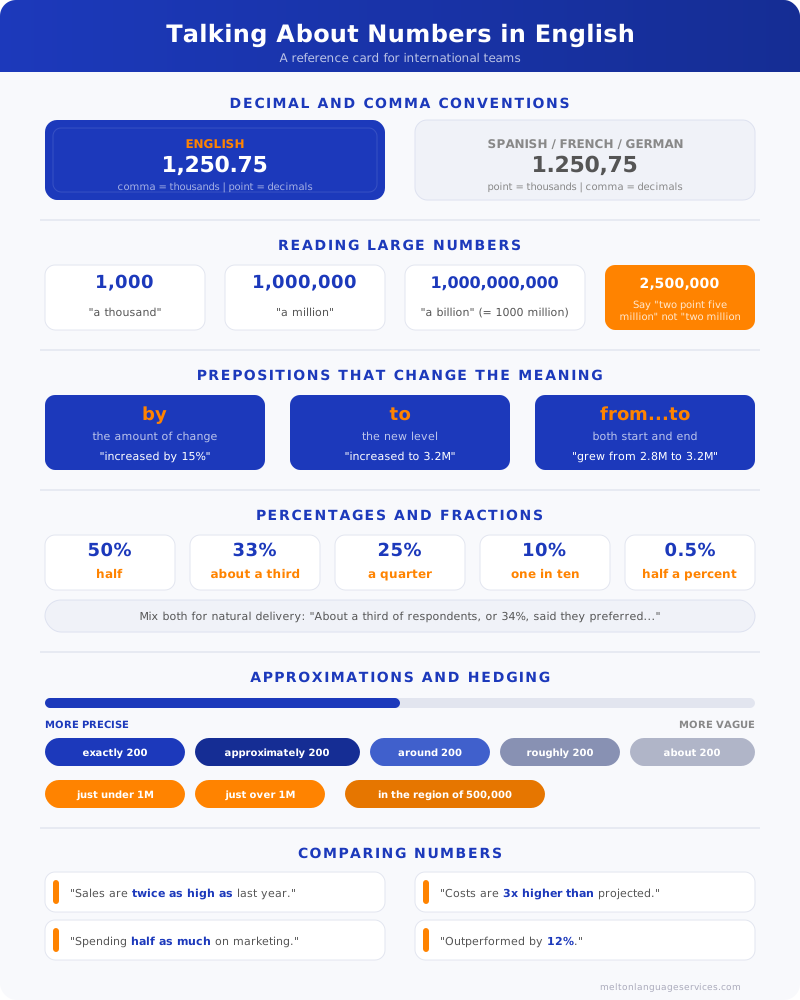
You are presenting quarterly results to a room of international stakeholders. The data is solid, your slides are polished, and then you say “one thousand two hundred and fifty comma seventy-five” when you mean 1,250.75. Suddenly, people are confused. The way English handles decimals, large numbers, percentages, and approximations trips up even advanced speakers, and in professional settings, small errors like these can undermine an otherwise strong performance.
Here is a practical guide to talking about numbers in English in a business context, covering the areas where professionals most commonly get tripped up.
The basics that catch people out
Decimals and commas
English uses a point for decimals and a comma for thousands. This is the opposite of many European languages.
- English: 1,250.75 (one thousand two hundred and fifty point seven five)
- Spanish/French/German: 1.250,75
Getting this wrong in a presentation can confuse your audience. Always double-check when switching between languages.
Large numbers
- Thousand: 1,000
- Million: 1,000,000 (note: “a million” or “one million,” not “a thousand thousand”)
- Billion: 1,000,000,000 (in English, a billion is a thousand million, not a million million as in some European conventions)
When presenting, say “two point five million” rather than “two million five hundred thousand.” It is clearer and faster.
Years
- 2026: “twenty twenty-six” or “two thousand and twenty-six”
- 1999: “nineteen ninety-nine”
- 2000: “two thousand” (not “twenty hundred”)
Presenting data in meetings
Introducing figures
- “If we look at the numbers for Q3…”
- “The data shows a clear trend.”
- “Let me walk you through the key figures.”
Describing trends
- Going up: increase, rise, grow, climb, surge, jump
- Going down: decrease, fall, drop, decline, dip, plummet
- Staying the same: remain stable, hold steady, level off, plateau
- Fluctuating: fluctuate, vary, be volatile
Adding precision
- “Revenue increased by 15%.” (the amount of change)
- “Revenue increased to 3.2 million.” (the new level)
- “Revenue increased from 2.8 million to 3.2 million.” (both points)
These prepositions matter. Mixing up “by” and “to” changes the meaning entirely.
Approximations and hedging
In business, you often need to be deliberately vague about numbers:
- “Roughly 200 clients” / “Approximately 200 clients”
- “Around 15% growth”
- “Just under a million” / “Just over a million”
- “In the region of 500,000 euros”
- “A significant increase” / “A modest improvement”
Hedging is not weakness. It is precision about uncertainty.
Percentages and fractions
- 50%: “fifty percent” or “half”
- 33%: “thirty-three percent” or “about a third”
- 25%: “twenty-five percent” or “a quarter”
- 10%: “ten percent” or “one in ten”
- 0.5%: “zero point five percent” or “half a percent”
In presentations, mixing percentages with fractions makes your language more natural: “About a third of respondents, or 34%, said they preferred…”
Comparing numbers
- “Sales are twice as high as last year.”
- “Costs are three times higher than projected.”
- “We are spending half as much on marketing.”
- “This quarter outperformed the previous one by 12%.”
- “The gap between revenue and costs has narrowed / widened.”
Common mistakes
”The 80% of companies…”
Drop the article. Say “80% of companies” not “the 80% of companies."
"It increased the double”
Say “it doubled” or “it increased twofold."
"The sales were of 2 million”
Say “Sales were 2 million” or “Sales reached 2 million.” No “of” needed.
Pronouncing “three” and “tree”
The “th” sound trips up many European speakers. Practise putting your tongue between your teeth. Your audience needs to distinguish “three million” from “free million.”
Talking about money and currencies
In international business, you frequently need to discuss amounts in different currencies. Here are some patterns that keep things clear:
- “The project budget is two hundred thousand euros.” (not “two hundred thousand of euros”)
- “We invoiced three point five million dollars last quarter.”
- “The exchange rate is currently one point oh eight dollars to the euro.”
When mixing currencies in the same discussion, always state the currency each time to avoid confusion: “The UK office spent fifty thousand pounds, while the Madrid office spent sixty thousand euros.”
Note that in English, the currency symbol comes before the number ($500, not 500$), and amounts are typically rounded in speech. Instead of saying “four hundred and thirty-two thousand six hundred and twelve euros,” say “approximately four hundred and thirty thousand” or “just under four hundred and fifty thousand.”
Practical exercises
Try these to build confidence:
- Read financial news in English. Pay attention to how journalists describe numbers and trends. The Financial Times and Bloomberg are excellent sources.
- Practise narrating charts. Take a graph from your work and describe it out loud in English. Record yourself and listen back.
- Present your team’s figures in English. Even if your colleagues speak your language, practising a data presentation in English builds the muscle memory you need.
Key takeaways
- Check your decimal and comma conventions before presenting
- Learn the prepositions that go with numbers: by, to, from
- Mix percentages with fractions for more natural delivery
- Practise with real data from your own work context
- Approximation and hedging are valuable skills, not signs of uncertainty
Numbers tell the story. Make sure you are telling it clearly.